Estimated reading time: 5 minutes

First things first: the taxman’s teleconference. Mary had some last-minute data she needed to get to the tax man, and by 9:00 am, the call was complete; we do not go to jail! Yeah!!
Today we need to do some walking around and some beach combing, and get ready for a wild rest of the week!

There was still some rain in the area!
We walked around the hotel area, admiring the trees and landscaping, and we ran into a sea turtle swimming down the walkway.
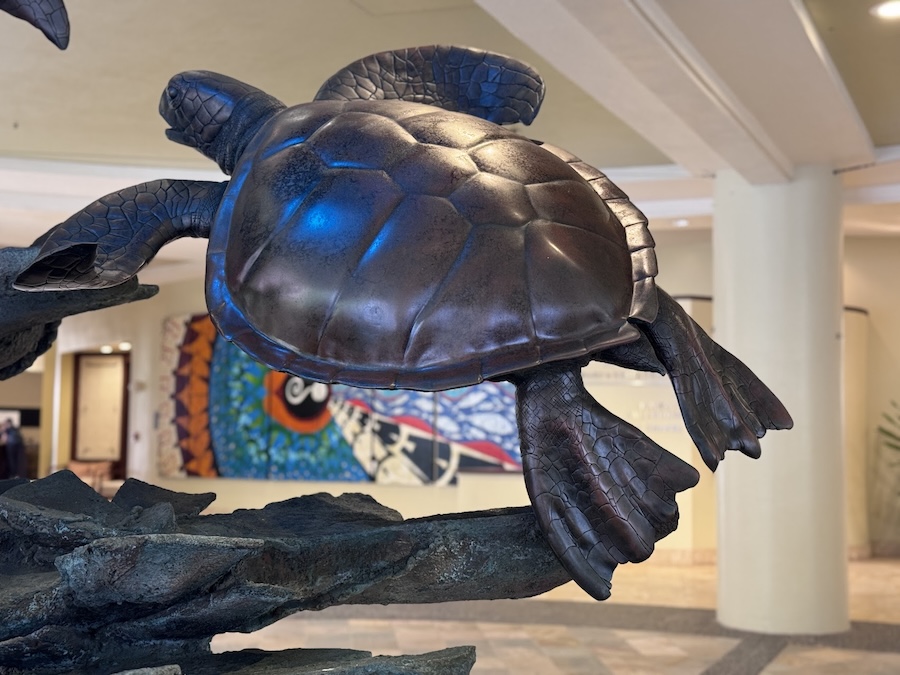
Yelling “Look, Turtle Soup” was not a good idea.
We immediately thought of Vicky and Jim when we saw the Ukulele store. We texted Vicky, and she said, “Buy one of each,” and we will take lessons and will perform for the Elks and Starlighters.

It was an amazing collection of instruments!
Out of the corner of her eye, she spotted a shop that did nails and toes. Her eye lit up, and I felt a pain in my wallet, but we wandered over to it anyway. I got to pick her toenail color, which turned out to be pomegranate red.

This is the closest thing to “going in the water” we have done the whole trip!
After the nails were ready for painting, Mary saw the color I had selected in the light and had second thoughts.

Are you sure???”
I sat with her, providing free kibitzing the entire time.
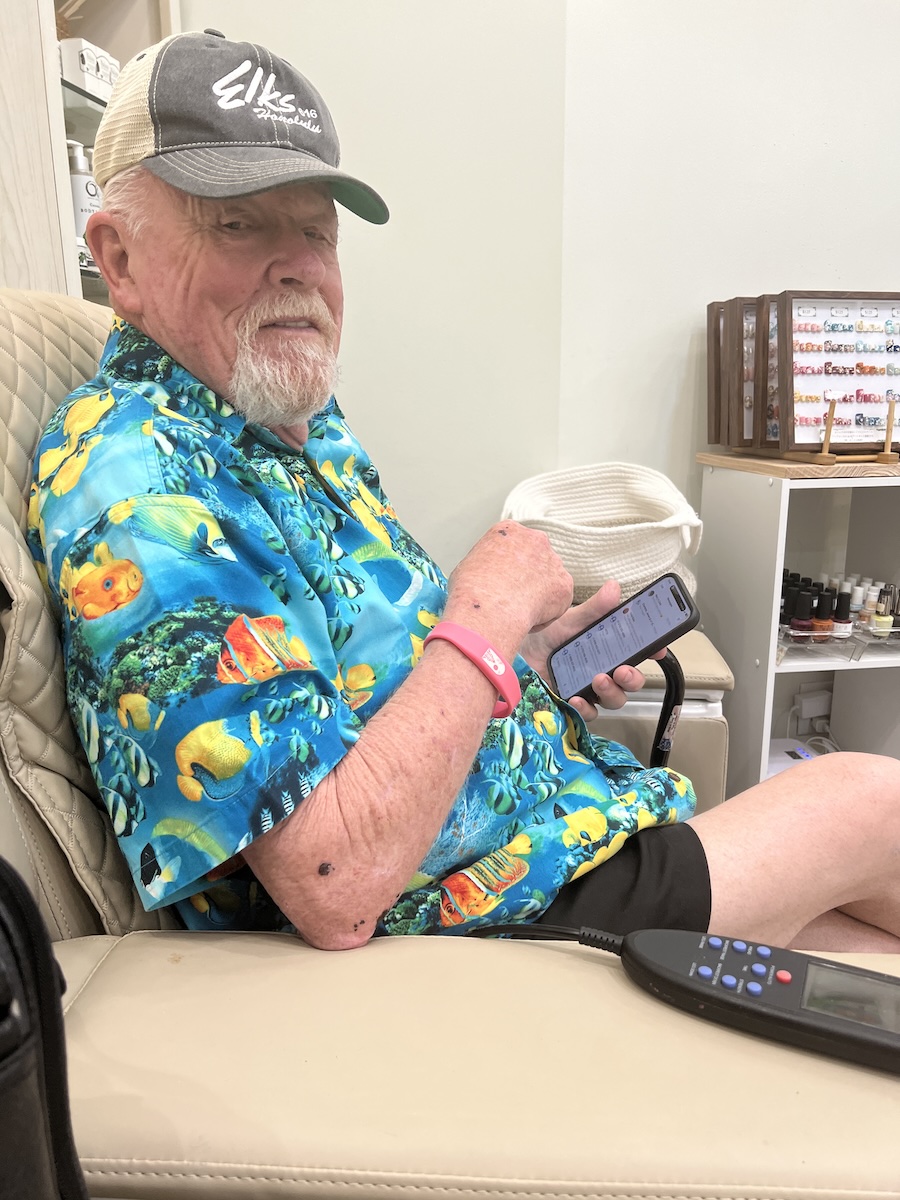
I did NOT charge extra for my company!
We mosied through the huge banyon trees on the property.
The Banyan Tree (Ficus benghalensis) is majestic. With thick woody trunks, vast canopies, and their signature root system, they’re hard to miss.
Though common in Hawaii, the Banyan tree is native to India. It was first brought to the Hawaiian Islands in 1873 by missionaries from India. The trees have become commonplace in Hawaii and are viewed as a prominent feature of the islands.
The Banyan tree, along with its associated flora, has a long history in religion, medicine, and pop culture.
The Banyan Tree (Ficus benghalensis) is majestic. With thick woody trunks, vast canopies, and their signature root system, they’re hard to miss.
Though common in Hawaii, the Banyan tree is native to India. It was first brought to the Hawaiian Islands in 1873 by missionaries from India. The trees have become commonplace in Hawaii and are viewed as a prominent feature of the islands.
The Banyan tree, along with its associated flora, has a long history in religion, medicine, and pop culture.

Baby Banyans were everywhere on the property!
Hunger was starting to hit hard, and on our island, that means one thing: it’s time for the Elks. So into a cab we went, like two starving celebrities whose only red carpet is the rubber floor mat.
We started with a drink, just enjoying each other’s company and pretending we weren’t mentally gnawing on the coaster. Mary went for the salad and tomato bisque soup, being all sensible and healthy, while I locked eyes with the sashimi special, which owed me money.
We polished off breakfast in a heartbeat.
We had a wonderful lunch and enjoyed our view of the Pacific Ocean looking south from the Lodge.

There were a lot of people out on their boards.
We returned to the hotel, and I rested on my poor back. There is an amazing assortment of flowers everywhere.

I told Mary she ought to go exploring while I rest and try to recover. She took me up on it and off she went.
A traditional Hawaiian boat is called a wa’a (canoe), and the most famous historical double-hulled voyaging canoe is the H’k-e’a. Other common types include the single-outrigger wa’a kaukahi and the double-hulled wa’a kaulua, traditionally used for fishing, transport, and inter-island voyaging.
Mary spotted a Wa’ a kaulua, which is the general term for a Hawaiian double-hulled voyaging canoe.

Ready for a ride?
The Sun was setting fast, so out came her camera and snapping started. Everyone on the beach was looking west to see the sunset.

The beach was empty, and the breakwater was full!
Mary found a willing accomplice and got a few pictures as the Sun set in the west.

Looking Good!
My back is still in a lot of pain, so we watched a movie, and I crashed around 9:00 pm. Tomorrow will be an interesting day, we are going to visit Megan and her dorm at Hawaii Pacific University.

In the 1960s, two small liberal arts colleges were founded by community members recognizing a need for private education in our newly formed state of Hawai’i. In 1992, a picturesque Windward College merged with a downtown university, uniting the strength of two academically strong institutions.
In 2014, the Oceanic Institute formally merged with the university, bringing additional multi-disciplinary research opportunities to HPU faculty and students. Aloha Tower Marketplace’s 2015 revitalization included oceanfront dorms and community gathering spaces.

