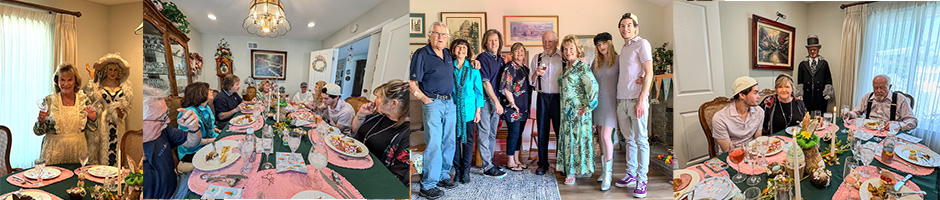

It’s 8:00 am on Saturday, we’re up, caffeinated, and pretending we’re the kind of people who get a lot done before noon. So far, the garden is scheduled to eat most of the day, and then we’ll reward ourselves by heading to Seal Beach for dinner with friends at Patty’s Place. A very balanced plan: one part productive, one part delicious, and one part” we’ll probably need a nap after this.”
Summary Of The Day: We went to the yard around 10:00 am and worked solidly until 3:00 pm, giving us enough time to rest, clean up, and drive to Seal Beach to meet Fast Eddie and Dianne at Patty’s Place.
While gardening, I had a lot of time to think about life and how very happy I am to have Dr. Mary in my life. We checked out the list together, and except for #3, we are doing well. #3 is in question only because of my incessant teasing, so I guess we do #3 also!

Then I think about my almost 82 years on this planet, how my Mom and Dad must have felt as they aged! Dad passed away at 64 and Mom at 84. It is sobering

What did we do today, you might ask? Mary took on her roses and gave them a proper haircut, turning them into a beautiful arrangement and making the whole house smell wonderful. I, meanwhile, wrestled with the lighting and drinking-faucet systems—because apparently my hobby is talking to wires and plumbing and hoping they listen.

The Sun charges these during the day, and at night, the yard is magically lit up free of charge.
The cucumbers are flowering, so they’re really coming on strong—apparently they’ve got big salad ambitions. Mary makes a mean Tzatziki Cucumber Salad, which is just cucumbers saying, “I came to impress.”

I think some cucumber salad is on its way!
Through her supernatural powers and trickery using an off-concealed magic wand, she transforms the lowly cucumber into magic.

Yummy!!!!!
I had to take three pictures because the lenses kept fogging up. The iPhone was complaining about having to take pictures of UGLY!
After working all day I was abominable, cantankerous, crotchety, disfigured, disgusting, ghastly, grotesque, gruesome, inelegant, odious, offensive, repugnant, repulsive, revolting, uglified, unappealing, unbeautiful, unhandsome, uninviting, unpretty, not to mention unsightly.
Oh my, my wrinkles have wrinkles!

I scared the scarecrow!
The corn is starting to form, and the silk—the “girl part,” all dressed up and waving in the breeze—is just standing there waiting for the “boy part” to show up so the whole family can finally get together and make kernels.
Here are a few corn sex trivia facts — in a harmless, botanical sense:
• Corn plants are monoecious: they have separate male and female flowers on the same plant.
• The tassel at the top is the male part; it produces pollen.
• The ear is the female part; each silk is connected to one potential kernel.
• Each silk must receive pollen to form a kernel, so one ear can have hundreds of silks.
• Corn is wind-pollinated, not insect-pollinated.
• If pollen doesn’t reach a silk in time, that kernel won’t develop.
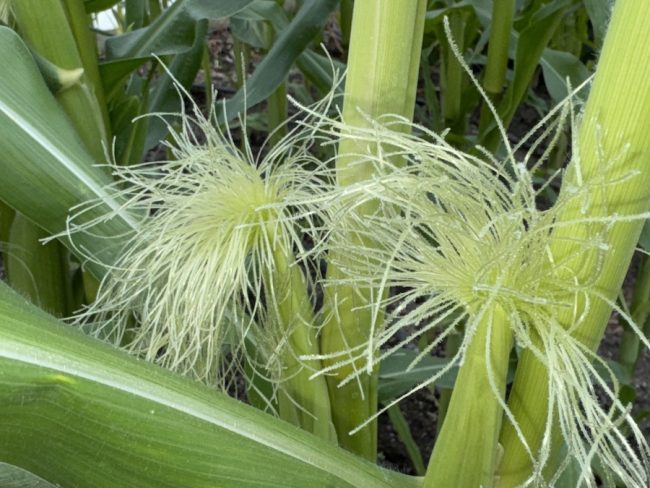
Hello girls! The boys are happy you are out and about!
Enough about the corn’s sex life, it is making me corny!
Around 3:00 pm, we ceased working and went inside to get gussied up. We are going to Patty’s Place tonight! Yeah!

We had a wonderful evening.
After driving home, we decided to crash!

