We got up early with Robin and had our coffee. We called Colleen, but she was out. Robin left around 9:00 am to visit her sister, and we got ready to leave for Whittier at 11:00 am for a noon birthday celebration at DeLuca’s Italian Restaurant. I remember when it was first opened back in 1967.
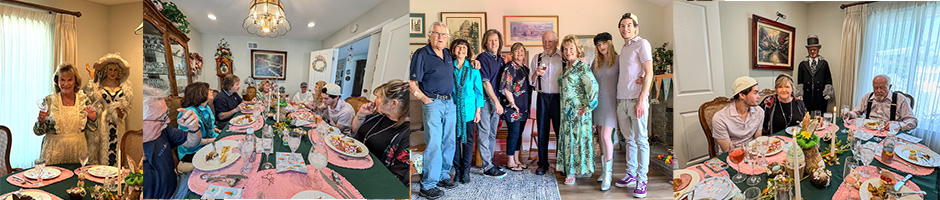
We enjoyed the party with over eighty people joining the fun.
The birthday Boy had a blast.
The cake erupted in flame, to celebrate 80 years!
We switched to the other camera, and the true Tony was revealed!
We had a wonderful meal, and we were smart enough not to eat everything; we have containers for tomorrow and probably the next day. During dessert, grandson Charlie joined us and talked about his first semester at Cal Poly and some of his classes. He is a very grown-up young man!
Charlie decided to get into the party mood!
Joe took 10,234 pictures, and I only snapped a couple,
Charlie, Alex, and Amy
Let’s get them into the mood!!!
Charlie, Alex, and Amy
Joe was busy during the party capturing pictures of old people doing crazy things!
Nice pants Joe!!!
We left around 4:00 pm, went home for a short nap, and didn’t wake up until 7:00 pm!
We watched TV for a while, then crashed because we get to meet Rory tomorrow!
After four years, Mary’s hearing aid finally died, so we made an 8:30 am appointment to get it fixed. We left the house at 6:45 am because the hearing specialist is in Newport Beach, and southbound traffic is horrible at this time of day.
Of course, there was no traffic, and we got there an hour early, so we stopped at Starbucks for a bagel and coffee before the appointment.
It turns out her hearing aid didn’t die; earwax blocked it, and within a few minutes, we could hear each other again. While we were in the office, we replaced the batteries, and after four years, that was all it took!
Huh??
We received an invitation from our audiologist to learn about the latest hearing-aid technologies. The biggest change from 2022 to 2026 is better AI for understanding speech in background noise, plus new wireless connections and more ways to adjust hearing aids on your phone. We decided it was good enough now, and we didn’t need to spend $14,000 yet!
Then we headed home; we had a small lunch, did some chores, and watched some of “The Way Home”.
Robin popped in at 4: 30 p,m and we departed for the Elks and Mamma Mia at 5:00 pm
We all got there around 5:30 pm and proceeded to terrorize the waitstaff behind the counter. Pasta flew everywhere, and I hate to mention what happened to the lasagne and pizza! The Lodge was all decorated for Halloween!
Of course, the subject turned to wine since it was Italian night.
Everyone was dressed to the hilt!
At the Elks event, Eddie and Dianne arrived in Italian folk outfits, vests, skirts, and ribbons, to confuse their friends. Frank practiced a tarantella, a lively, fast Italian folk dance traditionally danced to energetic music. It’s especially associated with southern Italy. The name links to the old folk belief that wild dancing could cure a tarantula bite.
Dianne carried breadsticks. The DJ, Ronnie, struck up a tune, and Eddie spun so enthusiastically that his fake mustache flew into the punch bowl. “Mamma mia!” cried Dianne, fishing it out with a breadstick.
The crowd cheered. Then the others in our group explained they were wearing costumes from three different regions—and Eddie’s hat was actually Swiss. Eddie bowed. “Excellent. I’ve always wanted international applause.” Dianne handed him the mustache, now marinated in fruit punch.
Diane and Fast Eddie
The Halloween subject was so hot and heavy that everyone wondered who was wearing it. Someone mentioned they were going to be a witch, and they were instantly challenged!
We were closest to the food and the dance floor — the best seats in the house! Since Ronnie was DJing, we did not have to worry about our ears being blown out. Ronnie does an amazing job of selecting dance music for us old folks and adjusting the volume so we can hear each other.
Lady and the Tramp redux.
Of course we have to dance, and Bob and Vicky showed us how it was done! They tore up the dance floor!
Vicky decided they needed a quick wardrobe change to “dance like a Cholo”. The Cholo/Chicana street culture belongs to the Mexican-American communities in Southern California.
Their style may combine:
Old-school soul, funk, and hip-hop steps
Pachuco-era zoot-suit dancing
Lowrider and barrio cultural aesthetics
Stylized gestures, footwork, body isolations, and group formations
Clothing such as pressed khakis, flannels, bandanas, work shirts, or zoot suits—depending on the era and setting
“Cholo” itself is a complex term. In some contexts, it refers to a Mexican or Mexican-American working-class identity and style; in others, it can be an insult or be associated with gang culture. Many people use related terms such as Chicano, Pachuco, or Sureño, but they aren’t interchangeable.
Poof! Thanks to AI magic, Bob and Vicky demonstrate Cholo/Chola dancing!
Mary and I wore “only normal” clothes, so we couldn’t keep up with Vicky and Bob. We did, however, add a little more music to the room!
I remembered how to play the squeeze box!
We actually sat down between dances and partook of the goodies!
Slurp, burp!
Ronnie the DJ brought the whole evening to life. He even handed out request sheets—though with everyone armed with cell phones and the Internet, he faced some stiff competition from the world’s largest jukebox. Ronnie was online too, so he fought fire with Wi-Fi and treated us to Frank Sinatra, Perry Como, Mel Tormé, Dean Martin, and other Italian singers for the rest of the evening. By the end, the request queue was faster than the music.
Go Ronnie, Go!!!
As Ronnie (or Renaldo this evening) always says, “Ballate per tutta la notte, amici miei… È bello rivedervi, quindi divertitevi!!”
Ronnie is an expert at selecting danceable line-dance music! His selections had the ladies jumping through hoops! Not only that, he taught everyone the “Cupid Shuffle: dance! To the right, to the right, to the right, to the right…..”
Robin, Vicky, Dianne, and Mary tore up the floor!
The men enjoyed the dancing so much we wanted to throw them roses, but alas, there were no roses available, so we did the next best thing. We gave them our tossed salads!
We emptied our salad plates in tribute to their magnificent efforts!!
We all departed around 9:30 pm and headed home. Robin is staying with us tonight, so we got home and spent about an hour laughing and giggling in the office!
We had a good day! We can hear the wind beginning to die down now, and we dined and danced the night away!
Just a little history: lilesnet.com (our website) was registered on Tuesday, 26th of December 1995, 30 years, 9 months, and 18 days ago, or 11250 days ago!
We have another full day, starting with a visit to the Elks for Girls Night Out, then a visit to the Muck.
Before leaving the Elks, we made reservations for Mamma Mia at the Elks. Friday, we will have us, Dianne and Fast Eddie, Robin, and Bob & Donna.
Get ready to say “Mamma Mia!”—it’s the Lodges’ annual Italian Night! Doors swing open at 5:30pm , and we will be greeted with hand-passed prosciutto and melon balls, plus bruschetta on grilled baguettes—more toasted than your uncle at a family reunion.
The Italian buffet kicks off at 5:30pm and rolls on until 8:00 pm, serving up spaghetti and meatballs, penne pasta Alfredo with chicken, Italian beef with onions, bell peppers, and marinara sauce, spinach raviolis piccata, shrimp scampi swimming in white wine and garlic butter, rice pilaf, veggies, and a pizza cart that’s rolling around like it owns the place, offering a smorgasbord of freshly baked pizzas. I can already see the bathroom scale getting nervous!
Pair it with the house Chianti for just $5 a glass. We will top it all off with spumoni ice cream, Italian cookies, and coffee!
Then dance it all off from 6:00 to 9:00 pm with DJ Ronaldo. Note to self: Wear dance shoes!!
After getting home, we took a short nap. At 4:30 pm, we heard someone come in through the garage door. It was our grandson Zachary
Zack, bless his soul, came by and started our 10KW generator since the weatherman is forecasting significant wind activity this weekend. That means we are likely to lose power! We know more wind is coming based on our gazebo, which blew its top off this morning.
We headed to the Muck at 4:00 pm, knowing it might take an hour. We got there, and the band was doing their “sound checks,” so we got some additional entertainment, albeit in small spurts!
Tonight it was just Vicky, Jim, and us! The four of us gab like school children, laughing and giggling the whole evening.
We, of course, came with a “Mary Basket,” meaning the picnic basket was bottomless; she found sandwiches, T-bone steaks, a whole watermelon, grapes, veggies, and, of course, six bottles of vino!! The basket is haunted!!!
We were dressed for the occasion!
The band played non-stop for 90 minutes, and we were stomping our boots and yelling “HOW-DEE” until we were hoarse.
At 9:30 pm, we headed home, but our GPS waived us off the freeway and took us down side streets to the 90, which is Imperial. Our GPS showed the 91 Freeway lit up red, so we avoided a long wait!
There was ZERO wind at the Muck, but by the time we got home, the wind was howling!
I emptied the trunk and went into the house on full automatic—which is how I ended up hanging the car keys on their hook without realizing I’d brought them inside. When I went back out to lock the car, the keys had vanished. Mary and I searched every bag, coat, and corner of the house. It was a mystery worthy of a detective show: How did we start the car, drive home, and somehow arrive without the keys?
I locked the car manually! Meanwhile, the keys remained at large. Probably hanging out on their hook, enjoying the drama.
We gave up and went straight to bed. It had been a long day, and the wind whistled outside like it knew where the keys were but wouldn’t tell. At least we were safe: Zack had started the generator, and it was out on the ship—right where I could get to it.
I knew the keys were somewhere and figured out the house was being haunted! It is that time of year!
Then I got to thinking, always a dangerous situation. I went to the key hanger in the closet, and there, smiling a toothless grin, were the keys playing hide-and-seek.
Being a homeowner is so much fun! Yesterday our ice maker died! With tools in hand, I got to work, but alas, after digging out all the ice to make sure it wasn’t frozen, I determined the unit was internally busted. So we called our handy-dandy appliance service, and after a few negotiations, they will be here Monday morning to replace it. Poof!!
As if that weren’t bad enough, it is torture day! Yes, self-induced bodily harm comes our way this morning as we enter the gymnastics twilight zone where simple, harmless-looking machines come to life and begin to twist and turn body parts into unnatural positions. It feels unnatural!!
While we were working hard, two visitors appeared in the corner of my eye. One looked suspiciously like a gym buddy; the other, one of our fitness instructors. Both wore red devil costumes, grinning and hiding their pointy tongues. They seemed delighted to watch poor Mary and me get tangled up in the torture equipment—apparently, even Hell has a spectator section.
Oh my, where are we???
Being curious, we had to take a closer look!
Sure enough, it was Leila and Najla
We were lucky to escape with our lives! From the gym, we flew by home and headed to Huntington Beach for our every six-week appointment to get our ears lowered. We grabbed a small bite next door at the Black Trumpet, and we filled up so we wouldn’t need dinner since we have a board meeting at our house tonight.
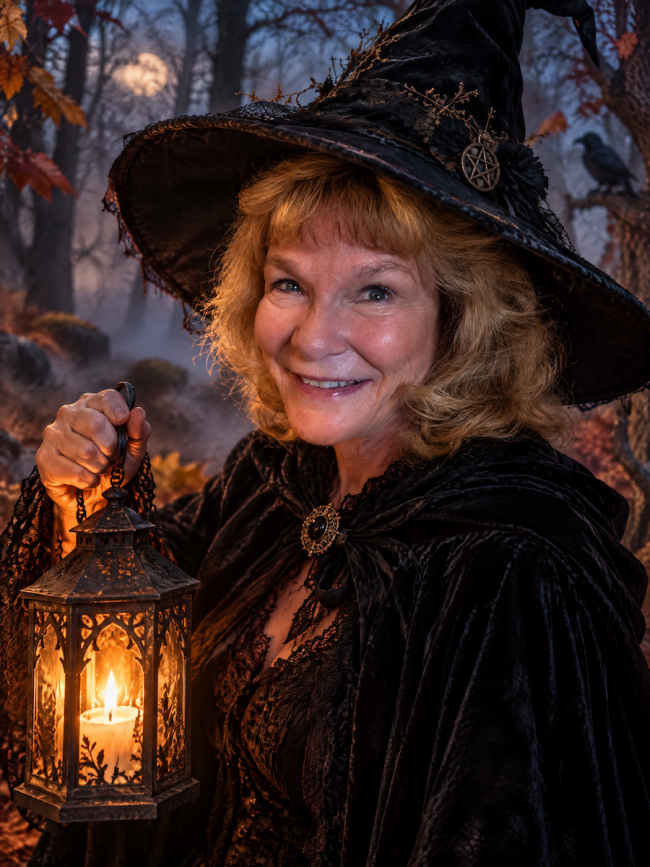
While gorging ourselves on delicious food, we kept thinking about the two devils, and then POOF, Mary changed! Since the Black Trumpet was dark, Mary decided to bring her own lantern!
She was so still I started to worry—until I asked her to move. Sure enough, it was Mary, using her lantern to signal the waitress for a glass of wine. Even in a crisis, she knew how to flag down service.
We went from the Black Trumpet to Casa Valencia at 34.3 times a broom’s speed.
When we arrived, so did our cleaning crew, and Domi knew she had to be done by 5:30 pm, so she worked fast. She and Maria finished around 5:35 p.m., and our Fearless Leader, Bob Z, showed up a few minutes later to get ready for the meeting. Getting ready consists of sipping a small glass of wine!
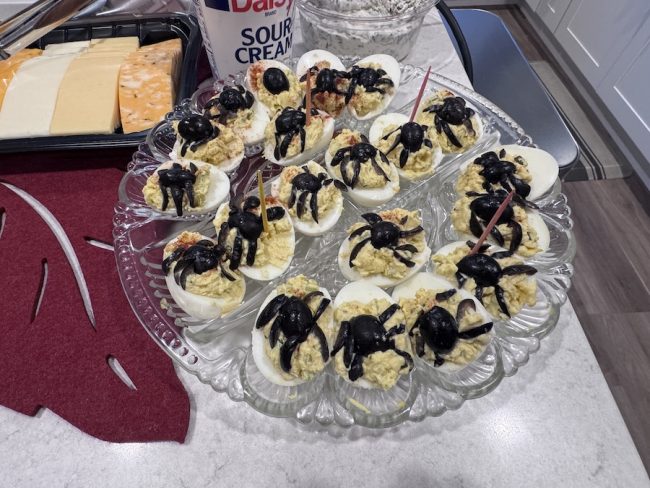
Mary finished off the kitchen island with all sorts of goodies. The famous spider eggs were on display, and several were devoured by the board members (the rest will come tomorrow, even in a picnic basket at the Muck)
The buffet was ready! We should weigh everyone in and out and charge by the pound for the difference as they leave,
Oh my, calories galore!!
The meeting opened for business with Bob, Vicky, and Mary as the main active parties. We finished in about 90 minutes, covering all the Starlighters’ business. Since we are all good friends, discussions go fast.
Bob, Iris, and Will
We have fun, and the meetings are NOT boring!
Mary kept us on track and took the meeting minutes.
As the meeting ended, Bob told us about the wonderful jacket he got for his 80th birthday from Fast Eddie. Bob is now the envy of several old motorcycle guys!
I, of course, immediately went to ChatGPT and explained what I was seeing in my mind!
After everyone left, Vicky and Jim unloaded their trunk into our garage with supplies for the upcoming festivities.
As Vicky got cleared for takeoff, Jim grabbed the dashboard in a death grip, and the White Thunder—Vicky’s racing car—blasted off. After the dust cleared and the neighborhood dogs stopped barking, Mary had a brilliant idea.
Mary decided it was warm enough to take three victory laps around the hood in her modernized Halloween witch-mobile. She was thrilled to have the battery-powered model. I was thrilled too: no more connecting every extension cord in the neighborhood and standing in the street as Mary attempted to escape last year’s model like a tangled-up witch on a leash.
Mary and I headed to the TV room and watched two more episodes of The Way Home before calling it a night. When sleepiness started closing in, I made the long trek to the back of the house to brush my teeth, take my nighttime pill, and fire up the breathing machine—basically my evening pit stop.
While I was there, I finished today’s entry. That brings us to 6,482 entries since we started in 2007: about 324 posts a year, or nearly one a day. At this rate, I’ll have enough material to bore future generations for centuries.
Today is Tuesday, so my favorite artist will leave Casa Valencia at noon and take the Silver Fox for a ride to the Tustin Senior Citizens Center. That also means I will work around the house on my personal to-do list, which keeps getting bigger and bigger! You can see her work in Mary’s Loft!
Sometimes we call her Dr. Messy!!
I no longer go upstairs! It’s Mary’s Loft!!!
Here are some interesting facts about watercolors:
• Watercolor paint is made from pigment and a binder, usually gum arabic, which helps the pigment stick to the paper.
• The paper often provides the white areas in a painting. Artists commonly leave parts unpainted instead of using white paint.
• Watercolor is usually transparent, so artists can layer thin washes of color. These layers are called glazes.
• Water controls the effect: more water makes paint lighter and more fluid; less water creates richer, more concentrated color.
• Once a wash dries, it can be reactivated with water, though some pigments lift more easily than others.
• Gouache is a related water-based paint that is generally more opaque than traditional watercolor.
• Watercolor has a long history, but it became especially popular for landscape painting and travel sketches because the materials are relatively portable.
• The paper matters a lot: watercolor paper is designed to handle water without buckling as easily as ordinary paper.
• Artists use techniques such as wet-on-wet (painting onto damp paper) for soft edges and wet-on-dry for sharper details.
With Mary gone, I’ve been tackling my personal to-do list—which appears to reproduce whenever I’m not looking. Today, I organized the TV Room components, hid the wires, identified the remotes, and labeled them, so we can smoothly switch between Halloween, Thanksgiving, and Christmas movies on CD or streaming. Naturally, I also did the laundry, fixed the Roomba, repaired every flashlight in the house, and downloaded photos from our recent trip on the Sony A6000.
I got to see the work of art for 30 seconds before I was whisked away to the market, since we are expecting the Starlighters Board tomorrow at 6:00 pm, and Mary is putting on a spread.
This will probably end up at Charlotte’s house!! Love the eyes!!
We went in for “just a few things” and somehow left $280 poorer—with some excellent steaks for Her Nibs and me, plus a couple of nice bottles of wine for our guests. So, really, the groceries practically paid for themselves.
When we got home, Mary went straight into homemaker mode: whipped up an amazing dinner, then got started on her specialty—egg spiders! Of course, making Halloween deviled spider eggs requires two things: the right costume and an appropriately spooky background. It’s in the recipe. Somewhere.
She had to be in costume!!! She is almost done adding the legs to the spiders!
For the rest of the afternoon and evening, we watched TV; we are almost halfway through The Return Home. I did some work on the computer, ran into a Facebook gift offer, and stopped dead! How did they know? We can hardly wait to go visit Rory on Monday!
Bringing back memories!
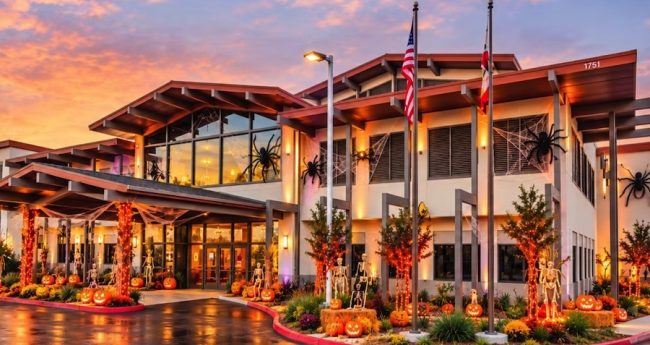
Later that evening, I started thinking about Halloween, which is coming up soon, and I decided to ask Charlotte to join us, at least for the first two hours! I was reminded of the Halloween Ball when I got the Elks bulletin about decorating the Lodge for Halloween!
Now that’s what we call decorating!!!
At least we have our costumes picked out, and they are ready to be unleashed on the world!
A beautiful lady and a handsome devil!!!
Finally, Mary will get to wear her new dirndl as we were back east when the Elks had Ocktoberfest. Below is a brief history of the dirndl:
The dirndl is now closely associated with Bavaria and Alpine festivals, but its history is more recent—and more complicated—than the idea of an unchanged “traditional” dress suggests.
Early 19th century: In German-speaking Alpine regions, rural people wore practical clothing shaped by local materials, work, climate, and custom. These clothes varied considerably by region and social class. They were not one standardized outfit called a dirndl.
Late 19th century: Wealthy urban visitors and artists became fascinated with Alpine life and its clothing. In the 1870s, Munich department-store owners Moritz and Julius Wallach helped popularize a fashionable version inspired by rural women’s dress. The garment’s name is linked to Dirndl, a Bavarian-Austrian word for a young woman; Dirndlgewand originally referred to a maid’s or working woman’s dress.
Turn of the 20th century: The dirndl became fashionable as both a holiday outfit and a symbol of regional identity. Clubs and associations promoted local dress, or Tracht, often formalizing styles that had previously been more varied and changing.
Nazi era: The Nazi regime promoted selected forms of German and Alpine folk culture, including traditional dress, as part of its nationalist imagery. This period politicized some forms of Tracht, but the dirndl itself was not invented by the Nazis; its modern fashionable form had become popular decades earlier.
After World War II: The dirndl was widely worn at regional celebrations and became a familiar symbol of Bavarian culture, especially through tourism and events such as Oktoberfest. Over time, designers and manufacturers adapted it for changing tastes, using different cuts, fabrics, and embellishments.
Today, the dirndl can be ceremonial regional dress, a fashion item, or festive clothing. Its details—such as apron style, bodice, skirt length, and decoration—may reflect particular local traditions, but many modern versions are contemporary designs rather than exact reproductions of historical work clothes.
We finally crashed around 10:30 pm. Tomorrow is another busy day!!
The calendar was turned, and the image of medieval people being tortured came into my rather overactive mind. Yes, it is gym day! We must go forth and submit to hours of pain and suffering only to look the same as yesterday!
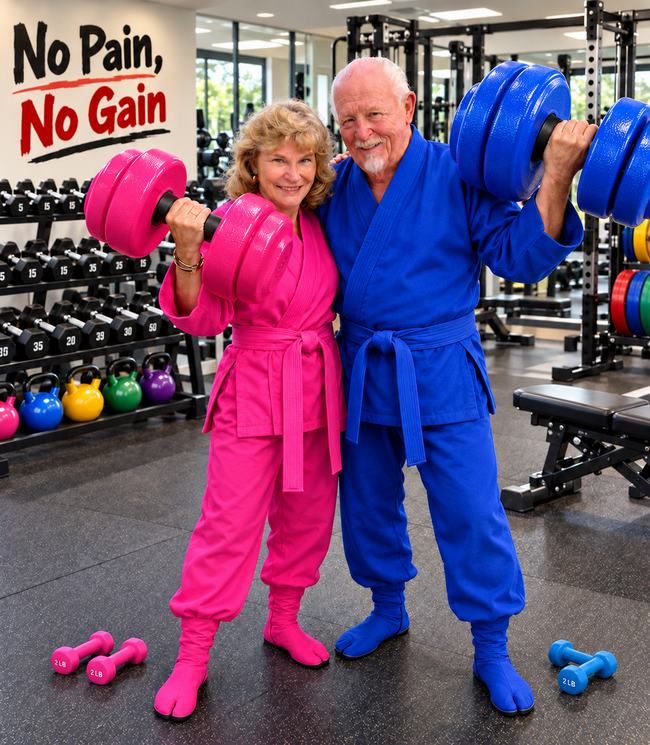
We dressed accordingly for the event!
They call us Pinky and Blue Boy!!
We got home and worked around the house all day. While Mary attacked her office desk, I attacked the garage workbench. For the rest of the day, all I saw was Mary at her desk sorting, filing, and looking puzzled! Her desk looks great, and she can use it for her art projects now!
We watched our TV series right in the office!
Around 7:00 pm, I pried her from the desk to make sure it was really Mary and not a pile of pillows! I was shocked; she had changed clothes and put on her accountant attire!
You can see both her desk and my workbench, and they’re actually usable!
The YouTube channel worked wonders!1
We crashed around 10:00 pm as tomorrow is another big day! We noticed the Christmas season social calendar is filling up quickly! James and Carol will join us for Halloween at the lodge, making our group 12. We bought tickets to see The Lettermen, and Vicy signed us up for Michael Bublé’s Christmas show at Spagatini!
We were ready to drive an hour to meet the new baby,y but Mother Nature had other plans. Just before we left, the breeder called and told us to come back because of the weather. We were supposed to meet in a neutral area, a park, but the forecast called for rain all day.
Rory has to wait another week!
We were all dressed up and had nowhere to go, so I suggested Rodrigo’s for lunch!
I took my combination bronchodilator, ipratropium bromide and albuterol sulfate, before we departed. It relaxes and opens the airways, which can ease wheezing, chest tightness, coughing, and shortness of breath. It’s commonly prescribed for COPD and sometimes other breathing conditions.
Spicy food, here I come!! Mexican food isn’t always spicy, but chiles are central to its culinary history. People have grown them in the region for thousands of years, and they add more than heat—flavor, aroma, color, and depth. Different chiles range from mild to very hot, and many dishes let you add salsa or chile to taste.
We parked on the street, right in front of the restaurant.
We had a glass of wine and carefully searched for something NOT spicy!
Mary was happy; she found something without spices!
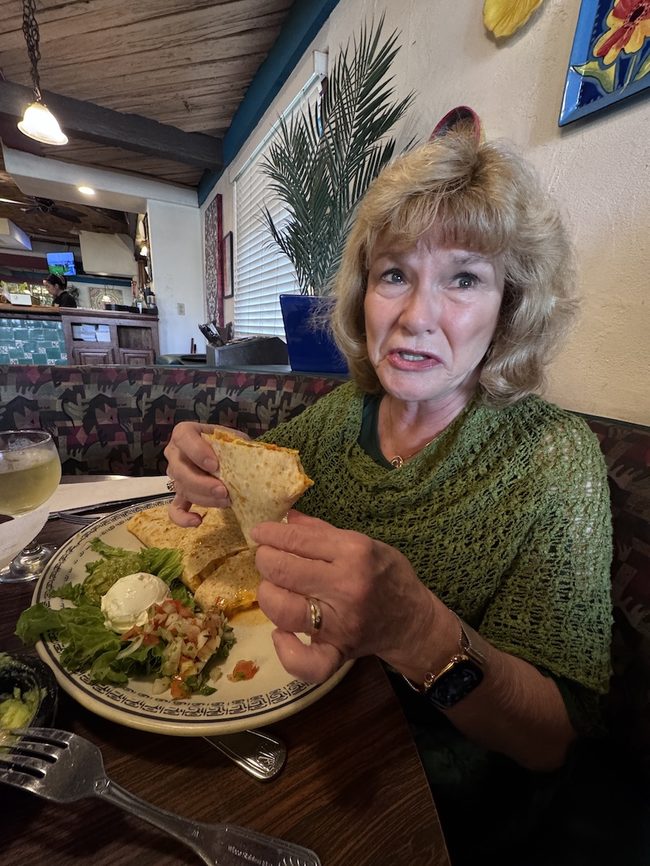
So she thought! A little cheese and chicken quesadilla ought to be just right!
Mary studied the menu with the seriousness of a bomb technician. “Chicken quesadilla, mild,” the waiter promised. “Absolutely no spice.”
“Perfect,” Mary said. She ordered it, confident her lunch would contain only chicken, cheese, and peace.
The quesadilla arrived, golden, crispy, and innocent-looking. Mary took a generous bite.
For one glorious second, nothing happened. Then her tongue began sending urgent letters to her brain. The chicken was hiding a crowd of hot chilis.
Mary turned bright red. Little flames flickered above her head. A nearby child pointed and whispered, “Mom, that lady is a dragon.”
Mary did not know what to do. She grabbed her water, but the waiter shouted, “Don’t! It makes the fire angrier!”
She fanned her mouth with the menu and accidentally ordered three desserts. Then she gulped a milkshake from the next table.
“Burn baby burn!!!”It’s hot!! I think there are peppers in this quesadilla!
At last, Mary cooled down and glared at the waiter. “You said mild!”
“I did,” he replied. “The chicken is mild. The chilis are visiting from a much hotter family.”
Mary looked at the remaining half. It winked.
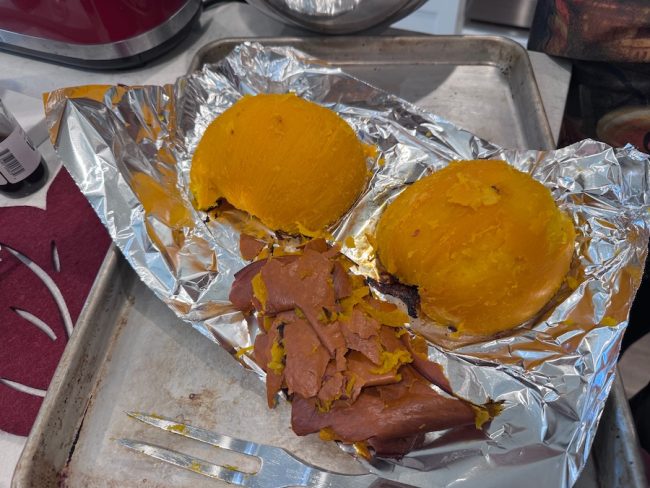
She pushed it away. “Pack that up,” she said. “I’m taking it home to someone I don’t like.” I will have one more small bite!
When I heard her scream, the real chili heat kicked into action. I immediately looked over and ran for the nearest fire extinguisher! Being a good husband, I finished her wine immediately, for fear the alcohol might catch fire too.
OUCH!!!
I, on the other hand, had made a safe selection.
Tostado Grande with spicy Chili Verde buried deep within!
After four glasses of ice water and wrapping a cold, wet towel around her throat, we headed home! I drove by Urgent Care, but Mary wanted to go home and rest!
NOTE TO SELF: Next time we go for Mexican food, bring Mary a peanut butter and jelly sandwich!
At home, we worked in the office, then watched some TV, and ended up on “The Way Home.” The series has 40 episodes across four seasons, with 10 episodes in each season.
The Way Home is a Hallmark family drama with a time-travel mystery at its heart. It follows three generations of the Landry family as they try to repair their relationships and understand a decades-old disappearance.
The premise: Kat Landry (Chyler Leigh) returns to her hometown of Port Haven, Canada, with her teenage daughter, Alice (Sadie Laflamme-Snow), after a difficult period in her life. Kat is estranged from her mother, Del (Andie MacDowell), and still haunted by the disappearance of her younger brother, Jacob, years earlier. Then Alice discovers the pond on the family farm can take her back in time.
As Alice visits the years when her mother was a teenager, she gets to know a younger Kat and uncovers family secrets. The time-traveling pond connects different generations, but its rules are mysterious—and changing the past may have consequences.
Across the series, the Landrys gradually piece together what happened to Jacob as they confront old grief, misunderstandings, and the choices that shaped their lives. The story mixes family drama, romance, small-town mystery, and gentle fantasy. Elliot (Evan Williams), Kat’s longtime friend, is also closely tied to the family’s past and the pond’s secrets.
It’s less about time-travel mechanics than about how parents and children see one another—and how understanding the past can change a family’s future.
We crashed around 10:30 pm. Tomorrow we face real danger as the day of the gym approaches—eek!!
Mary and I spent the day working around the house, but by mid-morning we were showing serious signs of Vicky-and-Jim withdrawal—so we called for a visit before things got worse. They arrived around 5, just in time for homemade corn chowder and two homemade salads, including Mary’s garden-fresh tabula. Housework: done. Friends: restored. Chowder: gone.
We’re old, but at 6:30 p.m. we decided to go for a swim. It was dark and raining, but that didn’t stop Mary, Vicky, and me from splashing around like little kids for an hour in the 93-degree pool.
Jim, the sensible one, stayed under the patio cover—dry, warm, and presumably judging us.
Afterward, we sat by the fire to “dry off.” In the rain. Apparently, at our age, we know better—but not better than we do.
Vicky and Jim left in Vicky’s “freeway flyer” (complete with flames painted on the car) around 8:00 p.m., and Mary and I watched TV. Within three minutes, we heard Vicky request landing instructions at Los Alamitos Airport on the runway named Kensington! In the background, we heard faint sirens.
Things are almost back to normal. We got up early, and I studied for my blood test, which is scheduled for 10:00 am. The allergy doctor wanted to draw blood, but when I gave him some paper and a handful of red Crayolas, he started talking to Mary instead
9:35 am sharp, I commanded The Silver Fox to take us to the medical building, and he answered with two backfires and a forward jerk, lunging toward the 55 freeway at breakneck speed.
On the way home, we passed Target and picked up some allergy goodies. We then stopped by Trader Joe’s to eliminate their oversupply of “Four Buck Chuck.”
Finally, we got home and rested. Mary started a pumpkin pie (from scratch) while I worked on the latest adventure website. Mary didn’t finish it before we had to leave, but it was “oven-ready”.
At 5:00 pm, Robn and family came in, and we headed to OC Mining Company for a family hello/goodbye dinner for Nick and Kayla. Michele and Franklyn joined us. The mining company is only about 1 1/2 miles from our home.
When we arrived, they DID NOT have our reservation. After some detective work, we determined that when I called in the reservation, the clerk apparently put Thursday the 8th on it, not Friday the 9th. We were seated, as we are good customers!!
We waited in the bar for only a few minutes while they made adjustments
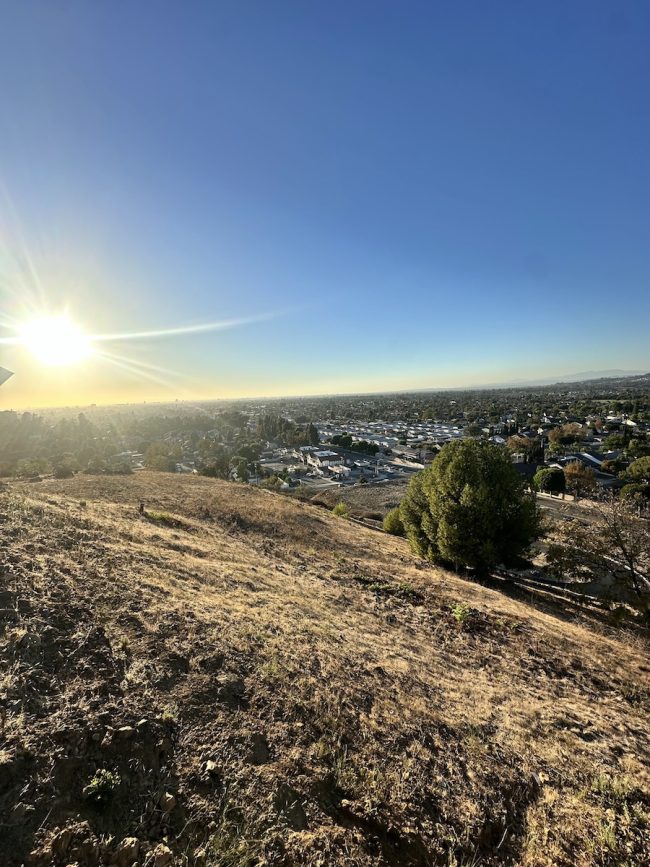
High on the hill overlooking Orange Ca
We enjoyed being together as family; this group is “the wild bunch.” It is a country/western facility, so everyone got dressed up as you can see below!
Then there was us.
Our hats had a flat!!
We put away a whole parcel of vittles—including two bottles of champagne and two of Chardonnay. Then we descended on dessert like a pack of pie-hungry bandits. Michele polished off the pie as if it had personally insulted her—and there might never be pie again!
Michele returned some tools I loaded for her project, and Bob and Franklyn loaded them into the van!
Robin and crew came by, and we told them the pool was 83 degrees, which sent them on a mad rush to the bedrooms to change. We stayed up until past 11:00 pm swimming and making s’mores!
Bob was a little cold when he got out! We told him to wear swimming attire, but alas…