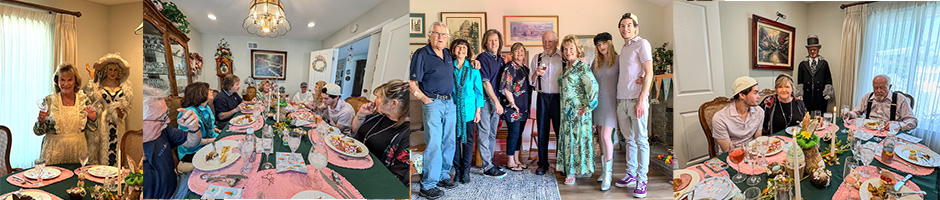

We were up at the crack of dawn, or 6:30 am, whatever comes first, and prepared The Silver Fox for a trip to Northern California, Camarillo to be exact. After cranking up the old girl (the car, not Mary), she kicked over, and engines were roaring.
It was off in a cloud of dust up the 55, to the 405, to the 101, to the 23, and we arrived at Dianne’s home right on time, where we met up with Megan and Steven, Mary’s grandkids!
The library was only about 25 minutes from our first stop.
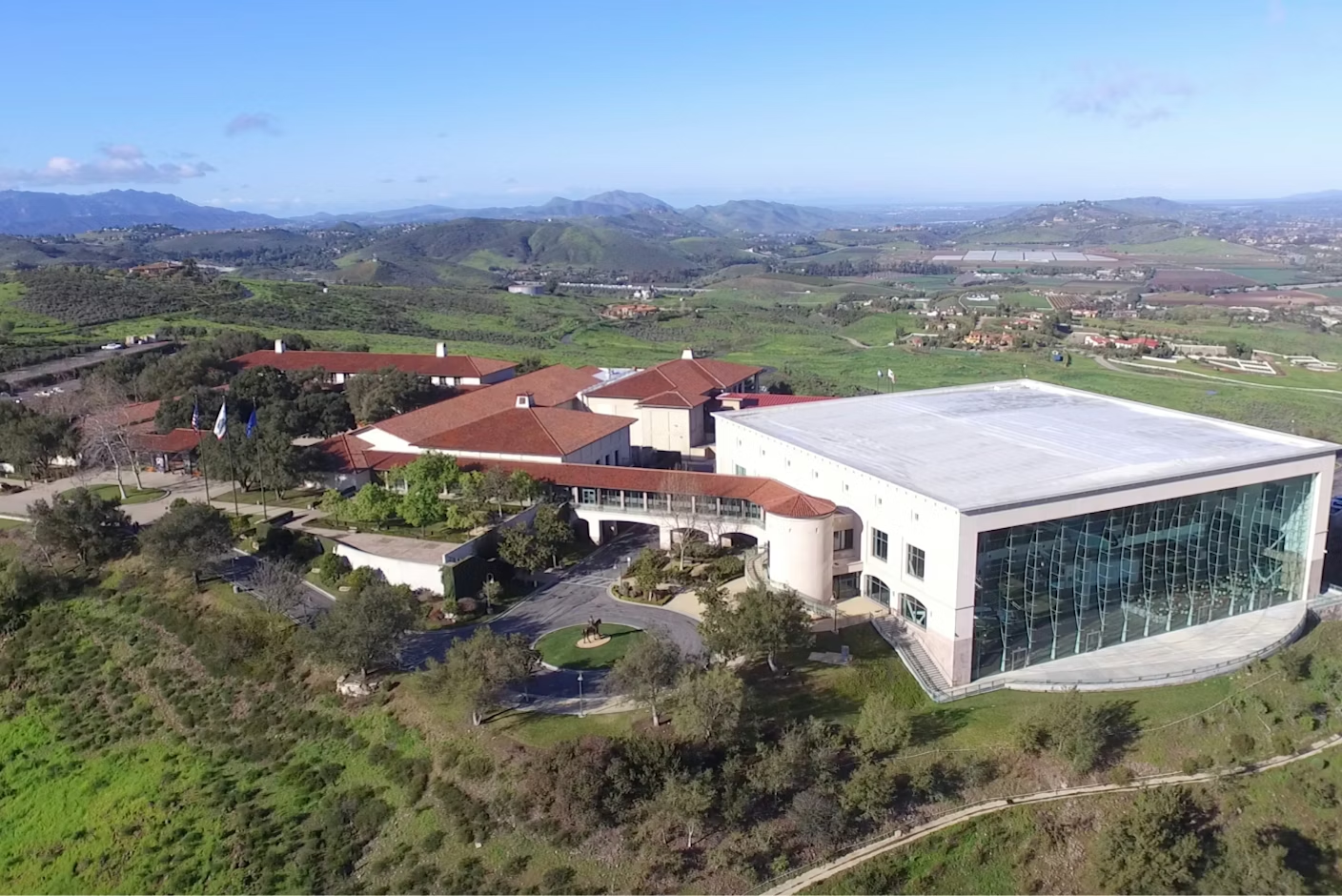
The library is a beautiful building high on a hill.
The weather was perfect, and the fires left a haze we had to deal with. The weather was perfect, and the fires left a haze we had to deal with.

We were greeted by one of the best presidents ever!
Before going in, we got our picture with The Great Communicator!

The four of them had a good time.
The exhibition pairs treasured artifacts with historical narratives, telling stories of the Founding Fathers alongside stories of lesser-known Americans whose grit and determination moved the nation forward.
From the Revolution through the Reagan era, this exhibition showcases the defining moments of the past 250 years, highlighting how every generation has been called to defend our liberties, strengthen civic life, expand opportunity, and uphold America’s defining principles.
The displays were extremely informative, things we did not learn in history class.
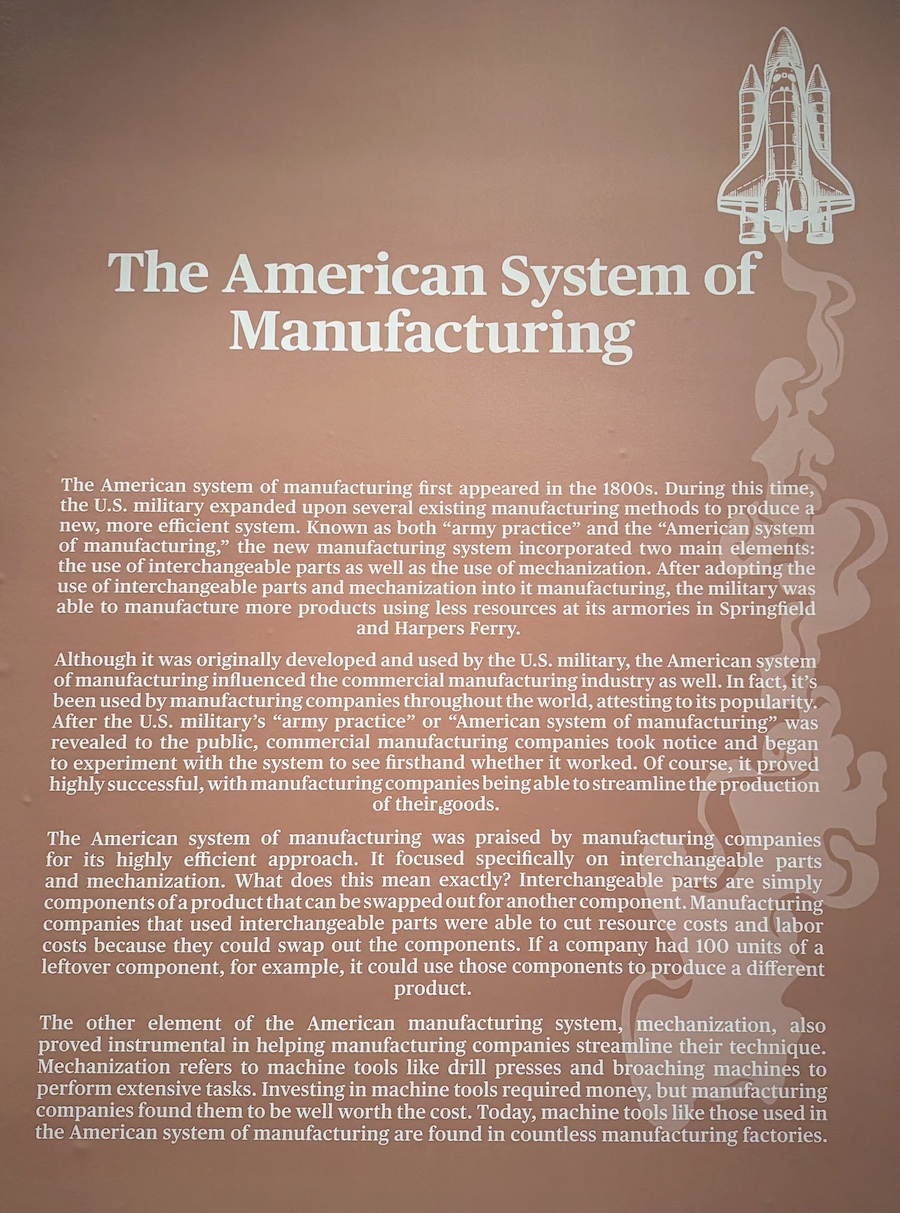
The America-250 exhibit was very interesting.
Welcome to the Gatling Gun. Here’s some Gatling gun trivia:
• It was one of the first successful rapid-fire weapons.
• Early Gatling guns were hand-cranked, not fully automatic.
• The rotating barrels helped prevent overheating, a major issue with early machine guns.
• It was used during the American Civil War, but only in limited numbers.
• Gatling claimed he invented it partly to reduce battlefield deaths by making armies smaller — an ironic idea, considering its destructive power.
• The original gun could fire around 200 rounds per minute, though later versions became much faster.
• It used multiple barrels that rotated around a central axis.
• Modern rotary guns, like the M134 Minigun and GAU-8 Avenger, are direct descendants of the Gatling concept.
• The massive GAU-8 Avenger used on the A-10 Thunderbolt II fires 30mm rounds and is sometimes described as “a gun with an airplane built around it.”
• Early Gatling guns were sometimes mounted on wheeled carriages, making them look like small cannons.
• True automatic machine guns like the Maxim gun eventually replaced the Gatling gun.
• Unlike the Maxim gun, the Gatling needed an external force — originally a hand crank — to operate.
• Some Gatling guns were used by the U.S. Army during the Spanish-American War in 1898.
• The name is often misspelled as “Gatling gun”, but the correct spelling is Gatling, after its inventor.

The Gatling gun and the patent images were on display.
Nancy is wearing high heels, so in reality, Nancy and Mary are about the same height!
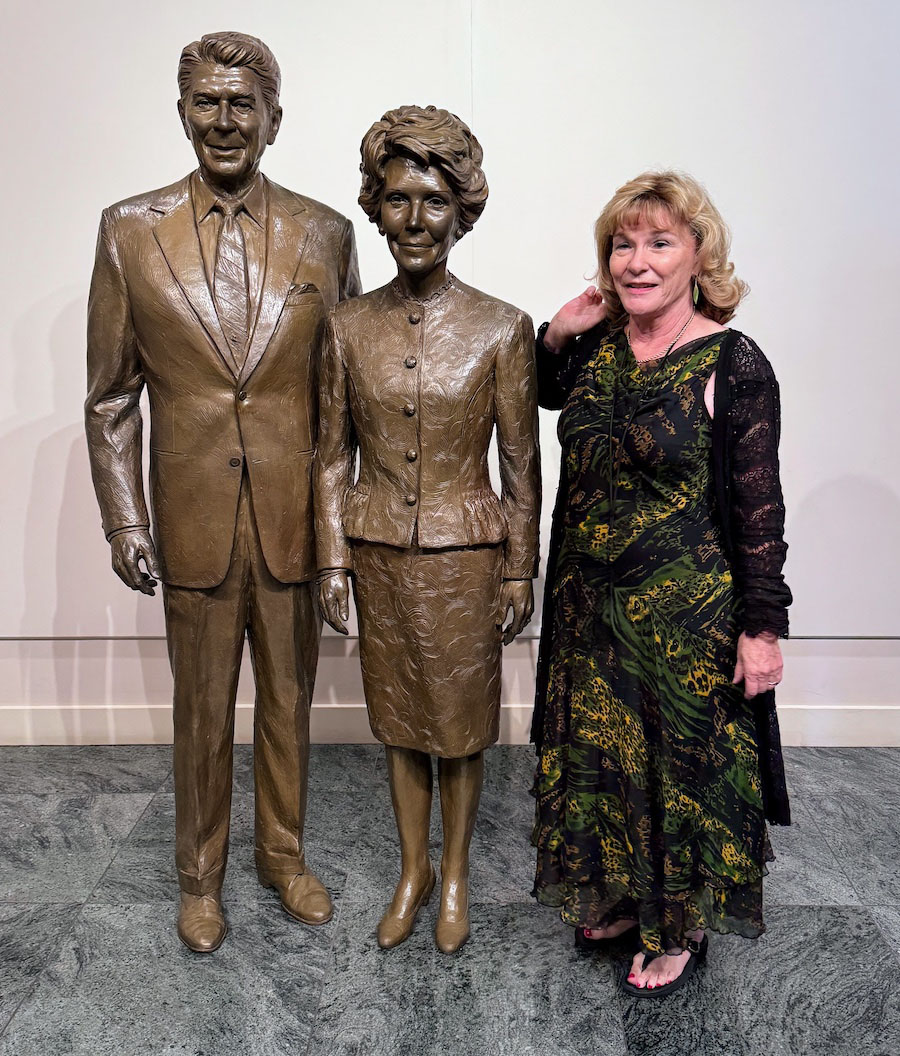
Mary introduces herself.
We are about to enter the normal library area after departing the America-250 area.
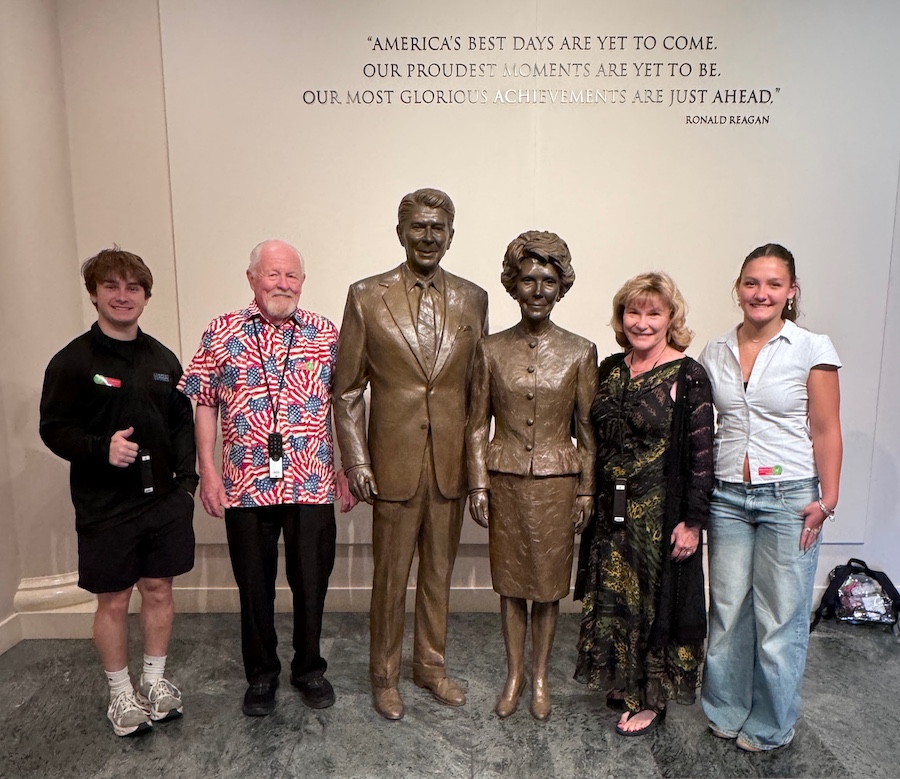
The gangs are all here.
Mary was ready to do a “snatch, grab, and run,” but we calmed her down, and she was satisfied She read about each of the dresses and their history.

Shall we go out?
After seeing many of the displays, we headed for “the hangar.” Air Force One during Reagan’s administration was tail number 27000.
Here’s some Air Force One trivia from the Reagan administration:
• During Ronald Reagan’s presidency, the main Air Force One aircraft was SAM 27000, a Boeing VC-137C, which was a military version of the Boeing 707.
• Reagan did not use the famous 747-style Air Force One that people often picture today. The current Boeing 747-based aircraft entered service in 1990, after Reagan left office.
• The 747 replacements, known as VC-25A, were actually ordered during the Reagan administration in 1985.
• Reagan’s Air Force One still wore the classic blue-and-white livery designed during the Kennedy era with help from Raymond Loewy, one of America’s most famous industrial designers.
• The aircraft’s tail number, 27000, is why it was commonly referred to as SAM 27000 when the president was not aboard. “SAM” stands for Special Air Mission.
• It was only called Air Force One when President Reagan was actually on board. If he wasn’t aboard, it used a different call sign.
• Reagan used Air Force One frequently to travel between Washington, D.C., and California, especially when visiting his ranch, Rancho del Cielo, near Santa Barbara.
• Reagan often called his California ranch the “Western White House,” and Air Force One trips to California became a regular part of his presidency.
• SAM 27000 carried Reagan to several major Cold War diplomatic events, including summits with Soviet leader Mikhail Gorbachev.
• Reagan used Air Force One for trips connected to major speeches and symbolic Cold War moments, including his 1987 visit to Berlin, where he gave the famous “Mr. Gorbachev, tear down this wall!” speech.
• The aircraft had secure communications equipment that allowed Reagan to stay in contact with military and government officials while airborne.
• Compared with modern Air Force One aircraft, Reagan’s 707-based plane was smaller, narrower, and had less range than the later 747s.
• SAM 27000 had already served presidents before Reagan, including Richard Nixon, Gerald Ford, and Jimmy Carter.
• After Reagan, SAM 27000 continued serving President George H. W. Bush until the new 747 Air Force One aircraft entered service.
• SAM 27000 was eventually retired and is now on display at the Ronald Reagan Presidential Library in Simi Valley, California.
• At the Reagan Library, visitors can actually walk through the aircraft and see the cabin used by Reagan and other presidents.
• Reagan’s Air Force One became closely associated with the image of the presidency during the final decade of the Cold War.
• Although the plane looked sleek and elegant, it was essentially a heavily modified Boeing 707, a design that dated back to the early jet age.
• Nancy Reagan influenced the style and presentation of Reagan-era presidential spaces, and the later 747 interiors reflected some of the elegance associated with that period.
• SAM 27000 is one of the most historically significant presidential aircraft because it served through a major era of Cold War diplomacy and remained in use for decades.
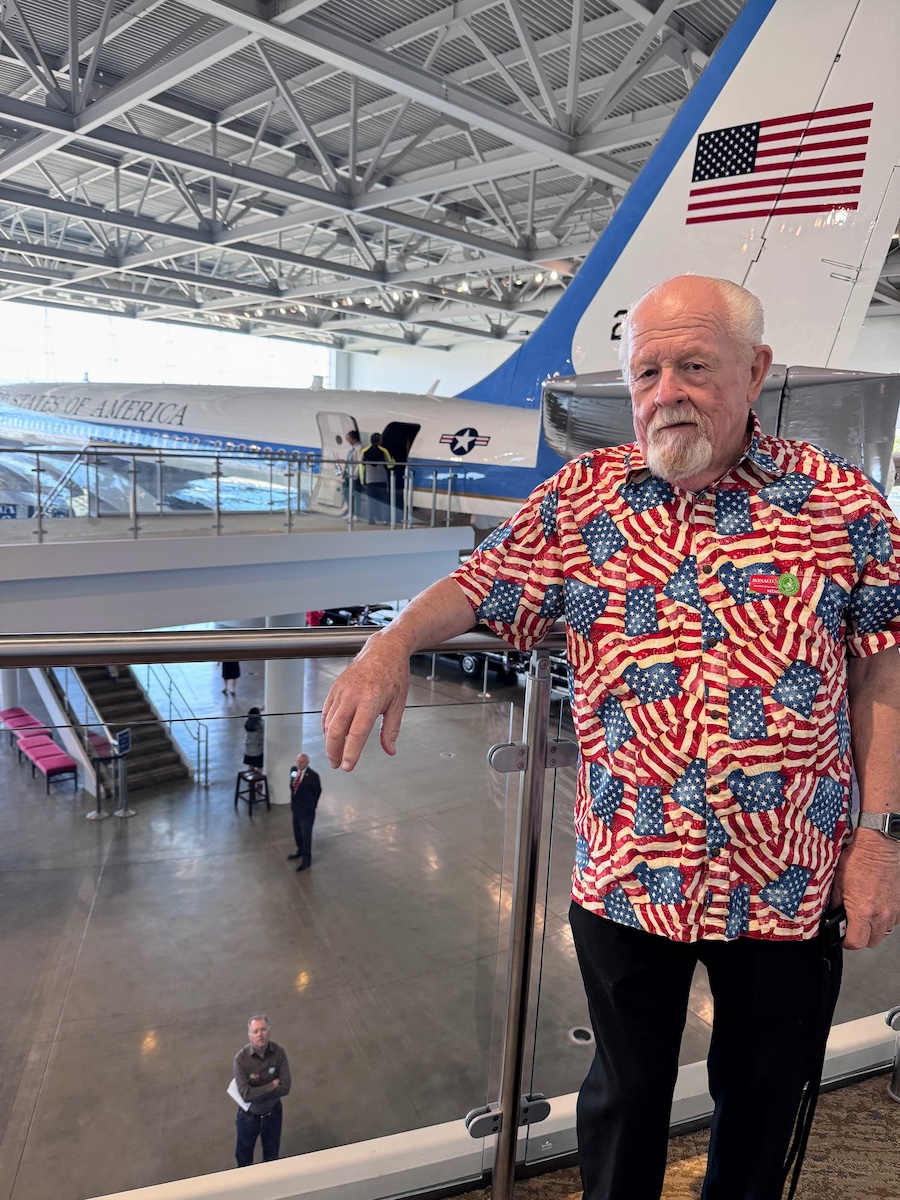
The airplane is beautiful
We are ready to walk through the airplane, which is a step back into history!

Just us!
I stopped at the communications center in front of the cabin, right behind the pilots. The area was fairly large and contained a lot of equipment, but I focused on the KG (Key Generator) boxes. I can’t say very much, but when I was working at Rockwell/Boeing, I dealt with these boxes. They were point-to-point boxes, and network-compatible boxes like the KG-250 have now replaced them.

I knew these KG boxes well.
Nice office, considering it flew at 35,000 feet and traveled the world.
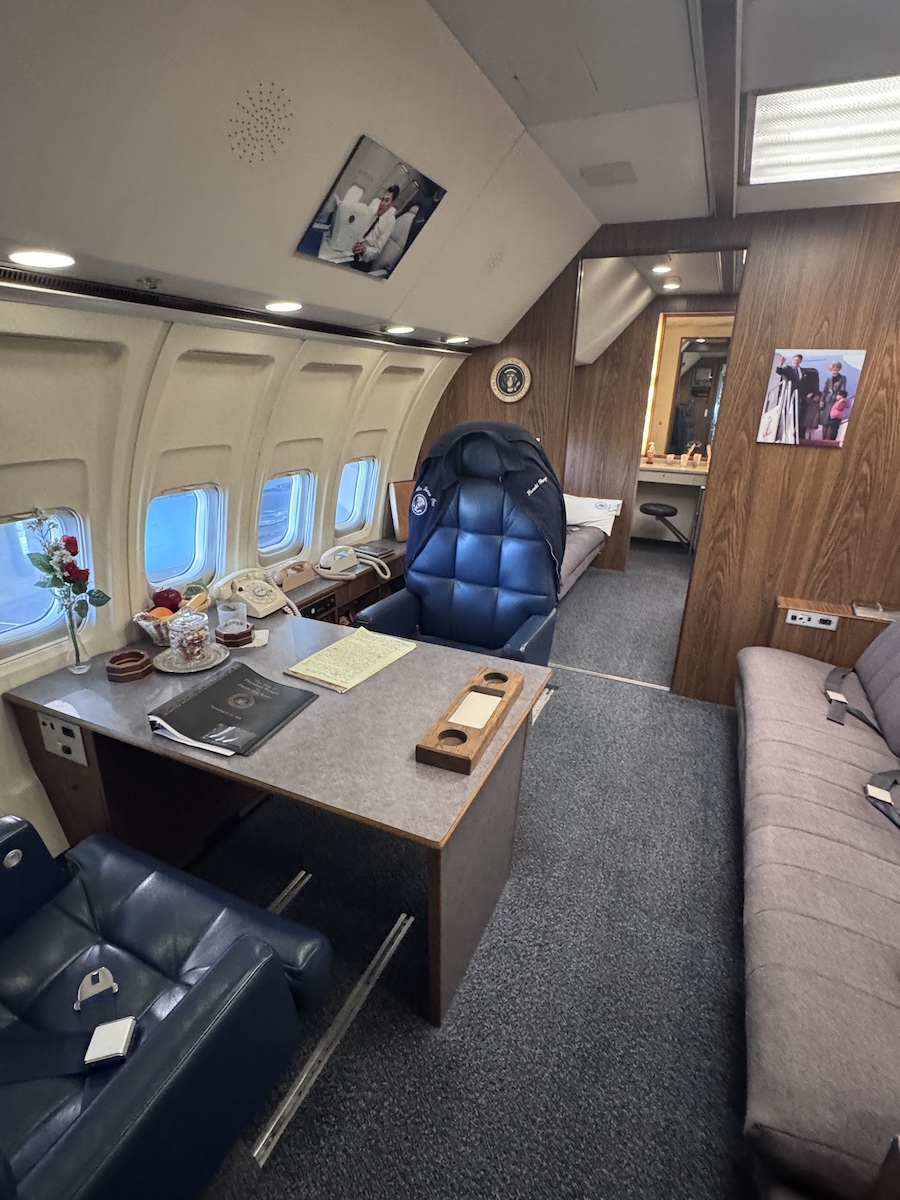
The president’s airborne office.
We also visited the helicopter.

After the museum, we headed to Bonnie’s home in nearby Moorepark. We stayed a while before heading home.
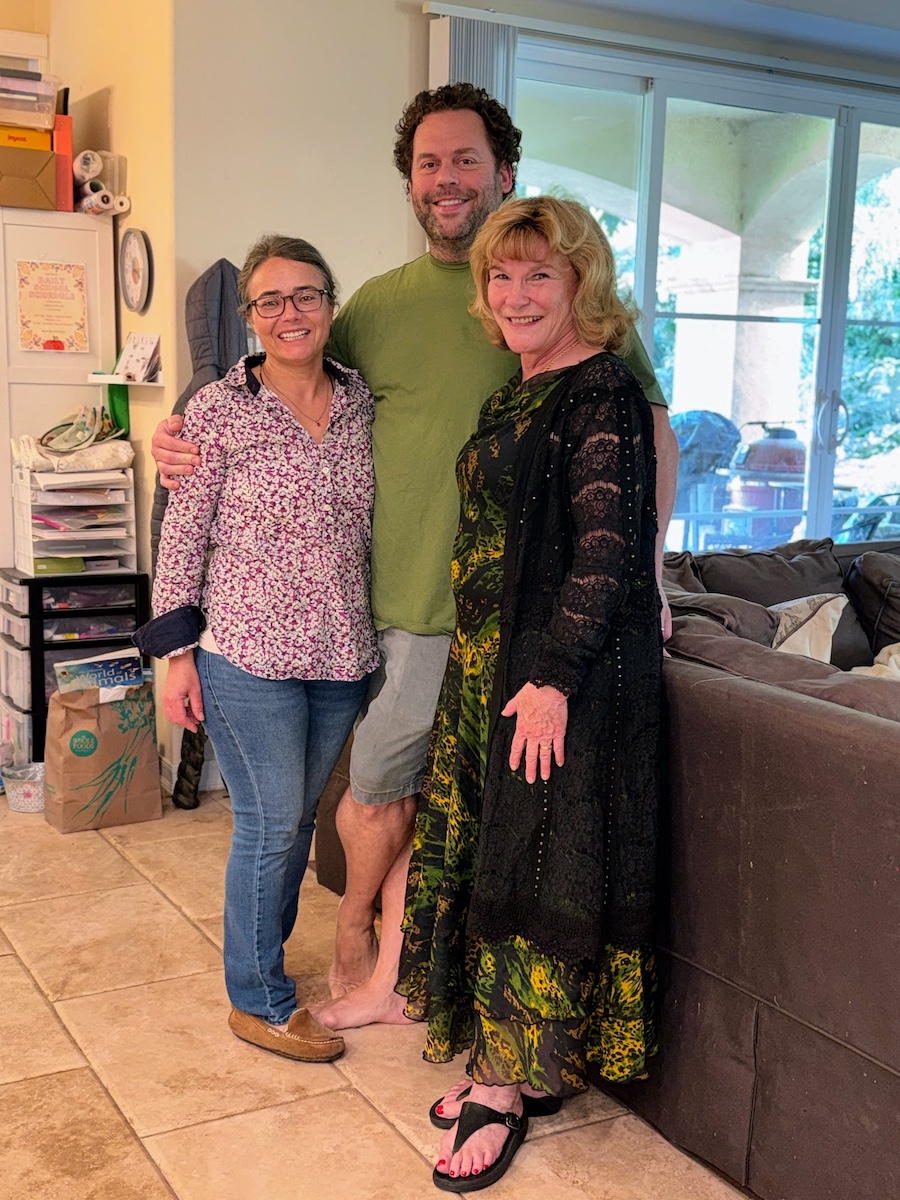
We visited Bonnie and her family before heading home.
It took over two hours to get home as I goofed and took the 118 into Interstate 5, which went through Los Angeles. As Mary said, “We have learned a lesson”.
When we got home, the banner was ready to be hung on our fence outside the house.
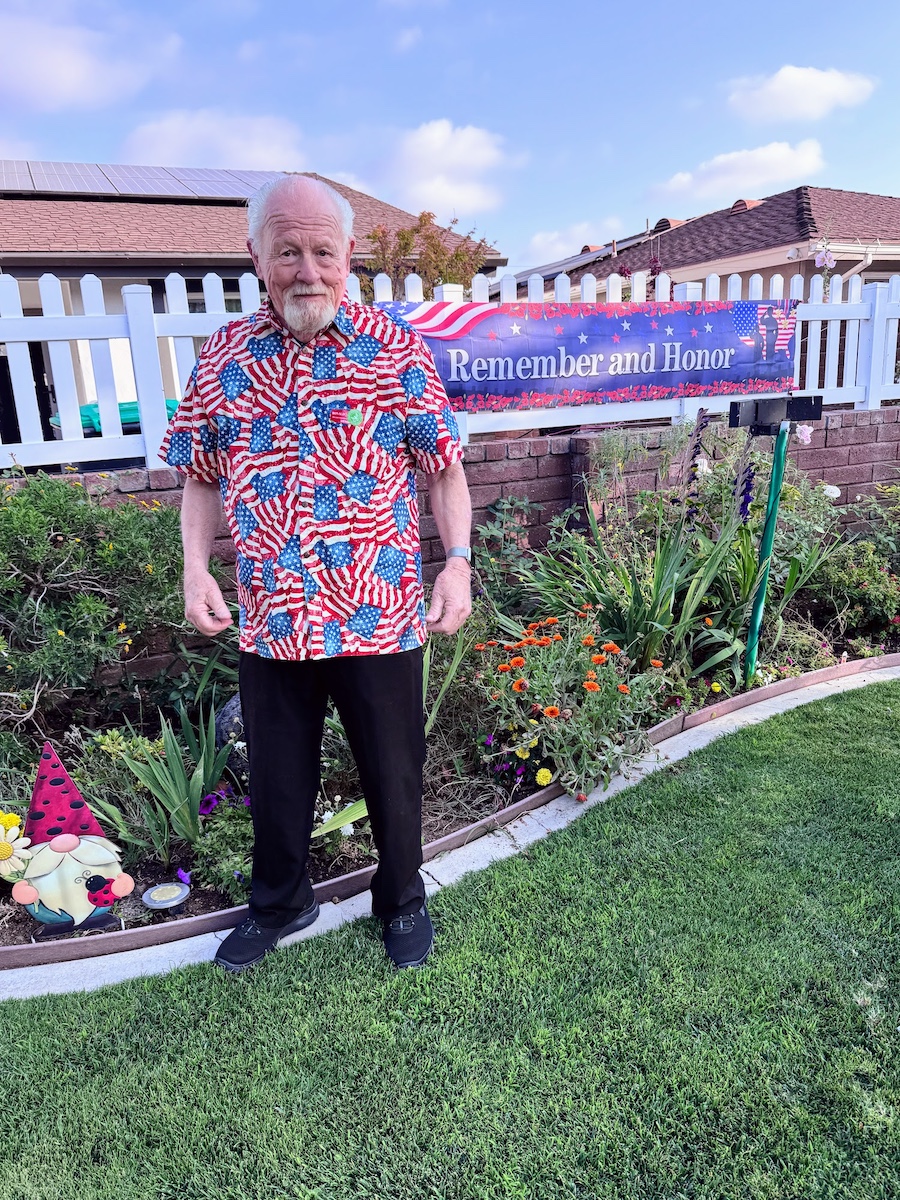
“A chicken in every garage and a car in the pot!”
We were pooped out, but we did decide to watch two episodes of “Dutton Ranch” before crashing at 10:00 pm.