
We’re up and ready to take on the day!! Since it’s Wednesday, our standing session with Peak Performance is at 8:30 am. First stop: the stationary bike—pedal, pedal, pedal… until it turns into an emergency “widdle break.” Then it’s off to the various torture machines, where we pay good money to be politely bullied by equipment designed by people who clearly love to see pain.
My back was hurting, so I offered to be taken to the mat and walked on by the small 250-pound torture expert without cleats today. After 40 minutes flat of my tummy only seeing my toes momentarily as they passed by my head, my back pain began to go away!
At 10:00 am, the pain subsided as we left the building and ran to the parking lot for the Silver Fox’s safety! It is a smart car because, as we entered and closed the door, it automatically locked us in and started up, placing the gearshift in the “P” position for panic. We zoomed out of the lot with tires screeching and rubber burning. We saw the tormentors chasing us in the rear-view mirror! They had pitchforks in their hands, and some carried torches!
Mary asked why I was driving so fast.

When we got home, we immediately went to the back patio and finished it off so it would be presentable to our guests who were scheduled to arrive at 4:00 pm. We knew they would both enjoy the garden tour!

We have flowers!
Everything is looking good, and we are ready to enjoy an afternoon tea on the patio, complete with Alexa playing our favorite tunes.

The mulch is in and looking good.
The red mulch makes the flowers stand out. The mulch keeps the roots from overheating from the Sun’s rays. Red mulch is usually made from shredded or chipped wood (often pine, cedar, fir, or recycled pallets/wood waste) that’s been dyed red.
Common decorative red bark ingredients/process:
• Base material: ground-up tree bark, wood chips, sawmill scraps, or recycled clean lumber
• Coloring: a water-based dye or iron-oxide pigment (iron oxide is essentially a “rust” pigment), sometimes with a binder to help it stick
• Sometimes: minor additives for dust control or color fastness

In a few weeks, they will be huge!
The hydrangeas are going to enter their “oversized, dramatic summer era,” so we’ll be keeping them politely humbled with a little strategic snipping as needed.
The name Hydrangea comes from Greek: hydor (water) + angeion (vessel), often explained as “water vessel,” referring to the plant’s high water needs and/or its seed capsules.

We love the color scheme!
The patio swing is now uncovered and ready for guests to enjoy the afternoon view. We put the swing on rollers so we can reposition it as needed.

Ready for Springtime on the patio!
Domi and the crew rolled in at 12:30 pm, and we immediately did what responsible adults do: went to BEVMO, then also Total Wine & More—because one store couldn’t possibly handle our weird requests.

Two stores later, and we have the ingredients. It looked like a police lineup, so I informed Mary that the problem was with #3
We stocked up for the legendary “Hershey Chocolate Martini,” which is totally clear, with the only evidence of chocolate being the Hershey’s Kiss in the glass! The recipe is simple:
• 2 oz vanilla vodka
• 2 oz chocolate vodka
• 2 oz clear crème de cacao
Dump the ingredients into a shaker, add a bunch of crushed ice, and shake like you just saw a ghost. Pour the elixir into a martini glass, drop in a Hershey’s Kiss, then step back and get ready—because this drink doesn’t get made so much as it gets even. It’s like drinking a chocolate bar but clear and cold!
We know you are curious how “chocolate vodka” can be clear, so…
Chocolate vodka stays clear by capturing the chocolate flavor without leaving behind the dark-colored solids (cocoa particles) that make things brown and cloudy. Producers typically do one (or a combination) of these three methods:
1 Use aroma/flavor extracts instead of cocoa, where they add natural/artificial chocolate flavor compounds (often based on vanillin/cocoa aromatics) that are nearly colorless. Since there’s little to no cocoa solid material, the vodka stays clear.
2 Distill the chocolate flavor by macerating cacao nibs/cocoa in neutral spirit, then redistill. Distillation carries over volatile aroma molecules (smell/flavor) but leaves behind most pigments and solids, so the distillate comes out clear.
3 Filter/clarify after infusion by removing color and haze using fine filtration (e.g., cellulose pads, activated carbon) and/or fining/clarifying agents. This can reduce both color and cloudiness, though heavy chocolate notes are harder to keep if you remove too much.
Why it works: the brown color in chocolate mostly comes from non-volatile pigments and suspended solids, which don’t carry over during distillation and can be removed by aggressive filtration. The chocolate aroma comes from compounds that can be captured without the color.
The clock is ticking, we got cleaned up, did a last-minute check on everything, and Carol and James arrived. This was their first meeting, as we thought they might hit it off and enjoy each other’s company!

This is Paul shooting at Mary!
We toured the garden and made the introductions before jumping in The Silver Fox and making our way to dinner at the Silver Trumpet. We enjoyed a delightful meal and got to know one another. The food was perfect as we shared a cheese board, I had Lamb Lollipops, Mary did their Lentil Soup, James attacked the Caesar Salad, and Carol went for the Salmon. Tummies are full, so it was time to go.

The menu was quite varied, and the plates were beautifully presented.
At 6:45 pm, we walked to Southcoast Repertory, which was perfect timing, as we sat down and got settled in, the play began.

We saw “Who’s Afraid of Virginia Woolf?”. Who’s Afraid of Virginia Woolf? by Edward Albee was first presented on Broadway on October 13, 1962.
The play’s title comes from the Disney song ” Who’s Afraid of the Big Bad Wolf?” from Three Little Pigs. It is commonly interpreted as meaning: “Who’s afraid of living without illusions?” In other words, who’s afraid of facing reality rather than comforting self-deception—one of the play’s central themes.
Summary: Who’s Afraid of Virginia Woolf? is a play by Edward Albee about one long, alcohol-fueled night in which a middle-aged couple, George and Martha, invite a younger couple, Nick and Honey, back to their house after a university party. As the night drags on, George and Martha’s vicious, flirtatious “games” escalate—humiliations, revelations, and shifting alliances that pull Nick and Honey into their marital warfare.
Through relentless arguments and mind games, the play exposes the lies each person uses to cope: George and Martha’s bitterness over disappointment and failure, Nick’s ambition and opportunism, and Honey’s fragility and avoidance. The evening builds toward the collapse of key illusions—especially the couple’s central shared fiction—ending with a bleak kind of honesty as George and Martha face what’s left when their defenses are stripped away.

Always a smile!!
We had NO idea the play was three hours long (because the play was based on “real-time” rather than hours or days)! We were thankful for the two intermissions!

The ladies are ready for the play to begin!
All had fun! While the play was performed quite well, we all decided something a little more light-hearted was more to our preference!
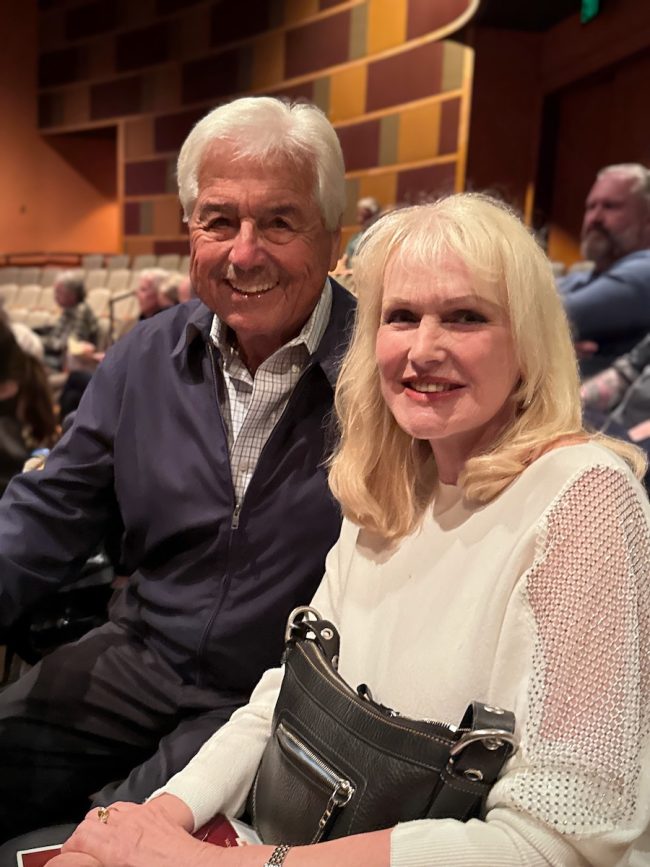
James and Carol
We walked back to the restaurant, and James retrieved his salad from the staff. We headed home, which was 16 minutes/11 miles. James got a kick out of the decorations, and the house was lit up all in green and orange for the upcoming holiday!
Good night, all, it was another amazing day!

