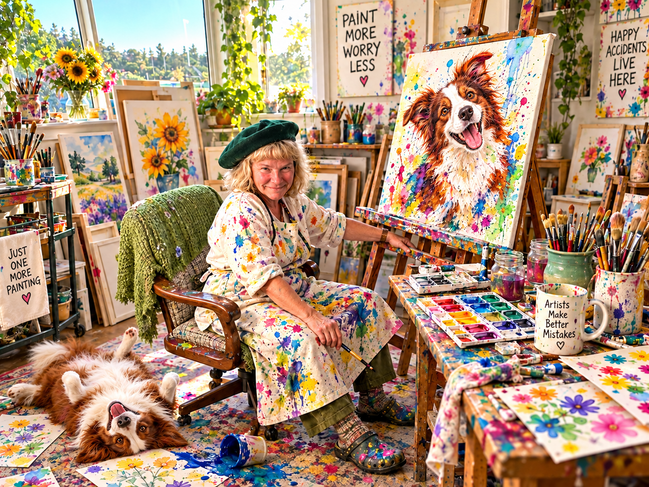
Today is Tuesday, so my favorite artist will leave Casa Valencia at noon and take the Silver Fox for a ride to the Tustin Senior Citizens Center. That also means I will work around the house on my personal to-do list, which keeps getting bigger and bigger! You can see her work in Mary’s Loft!
Sometimes we call her Dr. Messy!!
I no longer go upstairs! It’s Mary’s Loft!!!
Here are some interesting facts about watercolors:
• Watercolor paint is made from pigment and a binder, usually gum arabic, which helps the pigment stick to the paper.
• The paper often provides the white areas in a painting. Artists commonly leave parts unpainted instead of using white paint.
• Watercolor is usually transparent, so artists can layer thin washes of color. These layers are called glazes.
• Water controls the effect: more water makes paint lighter and more fluid; less water creates richer, more concentrated color.
• Once a wash dries, it can be reactivated with water, though some pigments lift more easily than others.
• Gouache is a related water-based paint that is generally more opaque than traditional watercolor.
• Watercolor has a long history, but it became especially popular for landscape painting and travel sketches because the materials are relatively portable.
• The paper matters a lot: watercolor paper is designed to handle water without buckling as easily as ordinary paper.
• Artists use techniques such as wet-on-wet (painting onto damp paper) for soft edges and wet-on-dry for sharper details.
With Mary gone, I’ve been tackling my personal to-do list—which appears to reproduce whenever I’m not looking. Today, I organized the TV Room components, hid the wires, identified the remotes, and labeled them, so we can smoothly switch between Halloween, Thanksgiving, and Christmas movies on CD or streaming. Naturally, I also did the laundry, fixed the Roomba, repaired every flashlight in the house, and downloaded photos from our recent trip on the Sony A6000.
I got to see the work of art for 30 seconds before I was whisked away to the market, since we are expecting the Starlighters Board tomorrow at 6:00 pm, and Mary is putting on a spread.
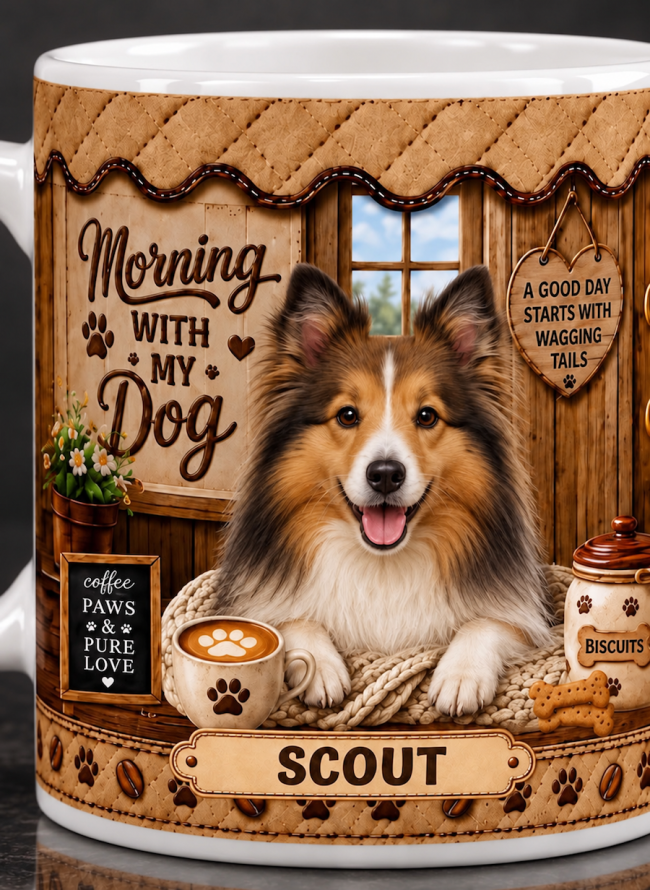
This will probably end up at Charlotte’s house!! Love the eyes!!
We went in for “just a few things” and somehow left $280 poorer—with some excellent steaks for Her Nibs and me, plus a couple of nice bottles of wine for our guests. So, really, the groceries practically paid for themselves.
When we got home, Mary went straight into homemaker mode: whipped up an amazing dinner, then got started on her specialty—egg spiders! Of course, making Halloween deviled spider eggs requires two things: the right costume and an appropriately spooky background. It’s in the recipe. Somewhere.
She had to be in costume!!! She is almost done adding the legs to the spiders!
For the rest of the afternoon and evening, we watched TV; we are almost halfway through The Return Home. I did some work on the computer, ran into a Facebook gift offer, and stopped dead! How did they know? We can hardly wait to go visit Rory on Monday!
Bringing back memories!
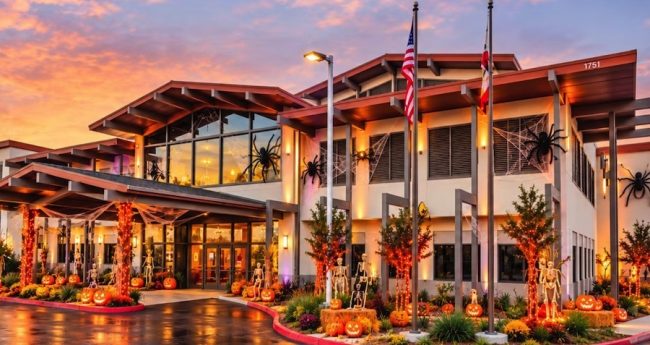
Later that evening, I started thinking about Halloween, which is coming up soon, and I decided to ask Charlotte to join us, at least for the first two hours! I was reminded of the Halloween Ball when I got the Elks bulletin about decorating the Lodge for Halloween!
Now that’s what we call decorating!!!
At least we have our costumes picked out, and they are ready to be unleashed on the world!
A beautiful lady and a handsome devil!!!
Finally, Mary will get to wear her new dirndl as we were back east when the Elks had Ocktoberfest. Below is a brief history of the dirndl:
The dirndl is now closely associated with Bavaria and Alpine festivals, but its history is more recent—and more complicated—than the idea of an unchanged “traditional” dress suggests.
Early 19th century: In German-speaking Alpine regions, rural people wore practical clothing shaped by local materials, work, climate, and custom. These clothes varied considerably by region and social class. They were not one standardized outfit called a dirndl.
Late 19th century: Wealthy urban visitors and artists became fascinated with Alpine life and its clothing. In the 1870s, Munich department-store owners Moritz and Julius Wallach helped popularize a fashionable version inspired by rural women’s dress. The garment’s name is linked to Dirndl, a Bavarian-Austrian word for a young woman; Dirndlgewand originally referred to a maid’s or working woman’s dress.
Turn of the 20th century: The dirndl became fashionable as both a holiday outfit and a symbol of regional identity. Clubs and associations promoted local dress, or Tracht, often formalizing styles that had previously been more varied and changing.
Nazi era: The Nazi regime promoted selected forms of German and Alpine folk culture, including traditional dress, as part of its nationalist imagery. This period politicized some forms of Tracht, but the dirndl itself was not invented by the Nazis; its modern fashionable form had become popular decades earlier.
After World War II: The dirndl was widely worn at regional celebrations and became a familiar symbol of Bavarian culture, especially through tourism and events such as Oktoberfest. Over time, designers and manufacturers adapted it for changing tastes, using different cuts, fabrics, and embellishments.
Today, the dirndl can be ceremonial regional dress, a fashion item, or festive clothing. Its details—such as apron style, bodice, skirt length, and decoration—may reflect particular local traditions, but many modern versions are contemporary designs rather than exact reproductions of historical work clothes.
We finally crashed around 10:30 pm. Tomorrow is another busy day!!
About Paul
Just an old retired guy trying to finish out my last years on this planet. I lost my best friend and wife in early 2020. I was blessed again by reconnecting with Dr. Mary Côté, a long-time friend. Mary and I got married July 28th, 2021, and are enjoying life together and plan to spend the rest of our lives being a blessing to our friends and family.