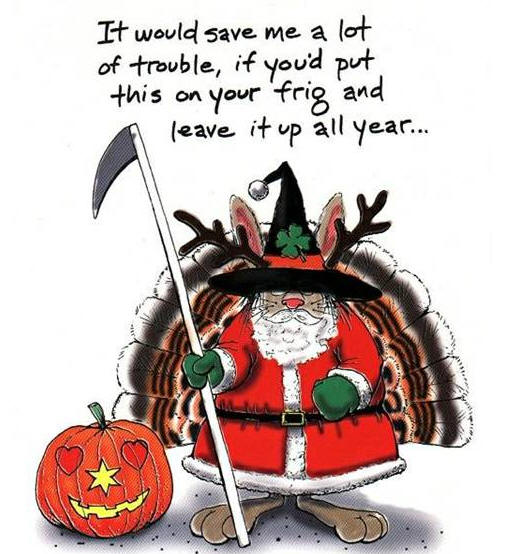
Check out the holidays for 2009 and 2010
We enjoy the holidays so please come and join in our activities. Strictly speaking, the United States does not have national holidays (i.e. days where all employees in the U.S. receive a day free from work and all business is halted). The U.S. Federal government can only recognize national holidays that pertain to its own employees; it is at the discretion of each state or local jurisdiction to determine official holiday schedules. There are eleven such "Federal holidays", ten annual and one quadrennial holiday. The annual Federal holidays are widely observed by state and local governments; however, they may alter the dates of observance or add or subtract holidays according to local custom. Pursuant to the Uniform Holidays Bill of 1968 (taking effect in 1971), some official holidays are observed on a Monday, except for New Year's Day, Independence Day, Veterans Day, Thanksgiving, and Christmas. There are also U.S. state holidays particular to individual U.S. states.
The word holiday has related but different meanings in English-speaking
countries. A contraction of holy and day, holidays originally represented
special religious days. This word has evolved in general usage to mean
any special day of rest (as opposed to regular days of rest such as
the weekend).
In the English-speaking world a holiday can mean a period spent away
from home or business in travel or recreation (e.g. "I'm going on holiday
to Malta next week"), the North American equivalent is "vacation". Many
Canadians will use the terms vacation and holiday interchangeably when
referring to a trip away from home or time off work. In Australia the
term can refer to a vacation or gazetted public holiday, but not to
a day of commemoration such as Mothers' Day or Halloween.
In all of the English-speaking world, a holiday can be a day set aside
by a nation or culture (in some cases, multiple nations and cultures)
typically for celebration but sometimes for some other kind of special
culture-wide (or national) observance or activity. A holiday can also
be a special day on which school and/or offices are closed, such as
Labor Day.
When translated from/to other languages, the meanings of the word "holiday"
may be conflated with these of "observance" and "celebration".
Valentines | St Patrick's | Easter | Independence Day | Halloween | Thanksgiving | Christmas | New Years
Valentine's Day or Saint Valentine's Day is a holiday celebrated on February 14. In the Americas and Europe, it is the traditional day on which lovers express their love for each other by sending Valentine's cards, presenting flowers, or offering confectionery. The holiday is named after two among the numerous Early Christian martyrs named Valentine.
The day became associated with romantic love
in the circle of Geoffrey Chaucer in the High Middle Ages, when the
tradition of courtly love flourished.
The day is most closely associated with the mutual exchange of love
notes in the form of "valentines." Modern Valentine symbols include
the heart-shaped outline, doves, and the figure of the winged Cupid.
Since the 19th century, handwritten notes have largely given way to mass-produced greeting cards. The sending of Valentines was a fashion in nineteenth-century Great Britain, and, in 1847, Esther Howland developed a successful business in her Worcester, Massachusetts home with hand-made Valentine cards based on British models. The popularity of Valentine cards in 19th-century America was a harbinger of the future commercialization of holidays in the United States.
Valentines | St Patrick's | Easter | Independence Day | Halloween | Thanksgiving | Christmas | New Years

We plan to go to the garden and get fresh cabbage
right from our garden!!
Saint Patrick's Day (Irish: Lá ’le Pádraig
or Lá Fhéile Pádraig), colloquially St. Paddy's Day or Paddy's Day,
is an annual feast day which celebrates Saint Patrick (circa 385–461
AD), one of the patron saints of Ireland, and is generally celebrated
on March 17.
Irish colonists brought Saint Patrick's Day to what is now the United
States of America. The first civic and public celebration of Saint Patrick's
Day in the 13 colonies took place in Boston, Massachusetts in 1737.
During this first celebration The Charitable Irish Society of Boston organized what was the first Saint Patrick's Day Parade in the colonies on 17 March 1737.
The first celebration of Saint Patrick's
Day in New York City was held at the Crown and Thistle Tavern in 1756,
and New York's first Saint Patrick's Day Parade was held on 17 March
1762 by Irish soldiers in the British Army. In 1780, General George
Washington, who commanded soldiers of Irish descent in the Continental
Army, allowed his troops a holiday on 17 March. This event became known
as The St. Patrick's Day Encampment of 1780. Today, Saint Patrick's
Day is widely celebrated in America by Irish and non-Irish alike.
Americans celebrate the holiday by wearing green clothing. Many people,
regardless of ethnic background, wear green-coloured clothing and items.
Traditionally, those who are caught not wearing green are pinched, though
this practice is in fact alien to those who actually come from Ireland.
Valentines | St Patrick's | Easter | Independence Day | Halloween | Thanksgiving | Christmas | New Years

Easter is the introduction to Springtime and new birth.
Easter (Greek: Πάσχα, Pascha or Pasxa)
is the most important religious feast in the Christian liturgical year.
Christians celebrate this day in observance of their belief that Jesus
Christ rose from the dead two days after his crucifixion (Easter Sunday,
commonly referred to as the "third day" including the day of crucifixion),
now estimated to have taken place between the years AD 26 and AD 36,
see also Chronology of Jesus. Many non-religious cultural elements have
become part of the holiday, and those aspects are often celebrated by
many Christians and non-Christians alike.
Easter also refers to the season of the church year called Eastertide
or the Easter Season. Traditionally the Easter Season lasted for the
forty days from Easter Day until Ascension Day but now officially lasts
for the fifty days until Pentecost. The first week of the Easter Season
is known as Easter Week or the Octave of Easter. Easter also marks the
end of Lent, a season of prayer and penance.
Easter is termed a moveable feast because it is not fixed in relation to the civil calendar. Easter falls at some point between late March and late April each year (early April to early May in Eastern Christianity), following the cycle of the moon. After several centuries of disagreement, all churches accepted the computation of the Alexandrian Church (now the Coptic Church) that Easter is the first Sunday after the first fourteenth day of the moon (the Paschal Full Moon) that is on or after the ecclesiastical vernal equinox.
Easter is gather the family time for a roast and good conversation. Connor is still an "egg hunter" which entertains the crowds.
Valentines | St Patrick's | Easter | Independence Day | Halloween | Thanksgiving | Christmas | New Years

Next to Christmas, our favorite since we are both flag waivers
In the United States, Independence Day,
commonly known as the Fourth of July or the Fourth, is a federal holiday
commemorating the adoption of the Declaration of Independence on July
4, 1776, declaring independence from the Kingdom of Great Britain. Independence
Day is commonly associated with fireworks, parades, barbecues, carnivals,
picnics, concerts, baseball games, political speeches and ceremonies,
and various other public and private events celebrating the history,
government, and traditions of the United States.
Independence Day, the only holiday that celebrates the United States,
is a national holiday marked by patriotic displays. Similar to other
summer-themed events, Independence Day celebrations often take place
outdoors. Independence Day is a federal holiday, so all non-essential
federal institutions (like the postal service and federal courts) are
closed on that day. Many politicians make it a point on this day to
appear at a public event to praise the nation's heritage, laws, history,
society, and people.
Families often celebrate Independence Day by hosting or attending a
picnic or barbecue, and take advantage of the day off and in some years,
long weekend to gather with relatives. Decorations (e.g., streamers,
balloons, and clothing) are generally colored red, white, and blue,
the colors of the American flag. Parades often are in the morning, while
fireworks displays occur in the evening at such places as parks, fairgrounds,
or town squares.
Independence Day fireworks are often accompanied
by patriotic songs such as the national anthem ("The Star-Spangled Banner"),
"God Bless America", "America the Beautiful", "My Country, 'Tis of Thee",
"This Land Is Your Land", "Stars and Stripes Forever", and, regionally,
"Yankee Doodle" in northeastern states and "Dixie" in southern states.
Some of the lyrics recall images of the Revolutionary War or the War
of 1812.
Firework shows are held in many states, and many fireworks are sold
for personal use or as an alternative to a public show. Safety concerns
have led some states to ban fireworks or limit the sizes and types allowed.
Illicit traffic transfers many fireworks from less restrictive states.
Valentines | St Patrick's | Easter | Independence Day | Halloween | Thanksgiving | Christmas | New Years

We enjoy Halloween and generally go to Disneyland and
come home to carve pumpkins
The modern holiday of Halloween has its
origins in the ancient Celtic festival known as Samhain; from the Old
Irish samain). The festival of Samhain is a celebration of the end of
the harvest season in Gaelic culture, and is sometimes regarded as the
"Celtic New Year".
Traditionally, the festival was a time used by the ancient pagans to
take stock of supplies and slaughter livestock for winter stores. The
ancient Gaels believed that on October 31, the boundary between the
alive and the deceased dissolved, and the dead become dangerous for
the living by causing problems such as sickness or damaged crops. The
festivals would frequently involve bonfires, where the bones of slaughtered
livestock were thrown. Costumes and masks were also worn at the festivals
in an attempt to mimic the evil spirits or placate them.

Scary time Halloween
We enjoy being home and awaiting the arrival of the kids all decorated in their costumes.. specially the "Rock".
The term Halloween (and its alternative rendering Hallowe'en) is
shortened from All-hallow-even, as it is the eve of "All Hallows' Day",
which is now also known as All Saints' Day. It was a day of religious
festivities in various northern European Pagan traditions,until Popes
Gregory III and Gregory IV moved the old Christian feast of All Saints'
Day from May 13 (which had itself been the date of a pagan holiday,
the Feast of the Lemures) to November 1.
In the ninth century, the Church measured the day as starting at sunset,
in accordance with the Florentine calendar. Although All Saints' Day
is now considered to occur one day after Halloween, the two holidays
were, at that time, celebrated on the same day. Liturgically, the Church
traditionally celebrated that day as the Vigil of All Saints, and, until
1970, a day of fasting as well. Like other vigils, it was celebrated
on the previous day if it fell on a Sunday, although secular celebrations
of the holiday remained on the 31st. The Vigil was suppressed in 1955,
but was later restored in the post-Vatican II calendar.
Valentines | St Patrick's | Easter | Independence Day | Halloween | Thanksgiving | Christmas | New Years

Time for Sue to work miracles in the kitchen and
generate massive amounts of delicious food!
In the United States, Thanksgiving or
Thanksgiving Day is an annual one-day legal holiday to express gratitude
for the things one has at the end of the harvest season, usually directed
to God.
It is celebrated on the fourth Thursday of November (i.e. the Thursday
falling between November 22 and November 28). The period from Thanksgiving
Day to New Year's Day is often collectively referred to as the "holiday
season," and the holiday itself is often nicknamed Turkey Day. Thanksgiving
is generally considered a secular holiday, and is not directly based
in religious canon or dogma.
The holiday's origins trace to harvest festivals that have been celebrated
in many cultures since ancient times, and most people celebrate by gathering
at home with family or friends for a holiday feast. A tradition also
exists to share the fruits of the harvest with those who are less fortunate.

Let's eat! The babies loved Thanksgiving
Abraham Lincoln's successors as president followed his example of annually declaring the final Thursday in November to be Thanksgiving. But in 1939, President Franklin D. Roosevelt declared that Thanksgiving would be the second-to-last Thursday of November rather than the last. With the country still in the midst of The Great Depression, Roosevelt thought this would give merchants a longer period to sell goods before Christmas. Increasing profits and spending during this period, Roosevelt hoped, would aid bringing the country out of the Depression.
At the time, it was considered inappropriate to advertise goods for Christmas until after Thanksgiving. However, since a presidential declaration of Thanksgiving Day was not legally binding, 23 states went along with Roosevelt's recommendation, and 22 did not. Other states, like Texas, could not decide and took both weeks as government holidays. Roosevelt persisted in 1940 to celebrate his "Franksgiving," as it was termed. The U.S. Congress in 1941 split the difference and passed a bill requiring that Thanksgiving be observed annually on the fourth Thursday of November, which was sometimes the last Thursday and sometimes (less frequently) the next to last. On December 26 of that year President Roosevelt signed this bill, for the first time making the date of Thanksgiving a matter of federal law.
Valentines | St Patrick's | Easter | Independence Day | Halloween | Thanksgiving | Christmas | New Years

Our favorite time of the year where family comes together
most of the time.
Christmas an annual holiday that celebrates the birth of Jesus. It refers to both the day commemorating the birth, and also the Christmastide season which that day inaugurates, concluding with the Feast of the Epiphany. The date of the celebration is traditional, and is not considered to be Jesus' actual date of birth. Christmas festivities often combine the observation of the Nativity with various cultural customs, many of which have been influenced by earlier winter festivals. Although nominally a Christian holiday, it is also observed as a cultural holiday by many non-Christians. Of note not all Christian denominations, like Jehovah's Witnesses, certain Seventh Day Adventist churches, and Members of the Living Church of God celebrate Christmas.
In most places around the world, Christmas Day is celebrated on December 25. Christmas Eve is the preceding day, December 24. In Germany and some other countries, the main Christmas celebrations commence on the evening of the 24th. The day following Christmas Day, December 26, is called Boxing Day in the United Kingdom and many countries of the Commonwealth, and called St. Stephen's Day or the Feast of Saint Stephen in Catholic countries. The Armenian Apostolic Church observes Christmas on January 6. Eastern Orthodox Churches that still use the Julian Calendar celebrate Christmas on the Julian version of 25 December, which is January 7 on the more widely used Gregorian calendar, because the two calendars are now 13 days apart.

It's Christmas
The prominence of Christmas Day increased
gradually after Charlemagne was crowned on Christmas Day in 800. Around
the 12th century, the remnants of the former Saturnalian traditions
of the Romans were transferred to the Twelve Days of Christmas (25 December
– 5 January). Christmas during the Middle Ages was a public festival,
incorporating ivy, holly, and other evergreens, as well as gift-giving.
Modern traditions have come to include the display of Nativity scenes,
holly and Christmas trees, the exchange of gifts and cards, and the
arrival of Father Christmas or Santa Claus on Christmas Eve or Christmas
morning. Popular Christmas themes include the promotion of goodwill
and peace.
Valentines | St Patrick's | Easter | Independence Day | Halloween | Thanksgiving | Christmas | New Years

Time for resolutions which we may or may not keep!
The New Year is an event that happens
when a culture celebrates the end of one year and the beginning of the
next year. Cultures that measure yearly calendars all have New Year
celebrations.
The most common modern dates of celebration are listed below, ordered
and grouped by their appearance relative to the conventional Western
calendar.
Many cities across the world celebrate the New Year. The celebrations
usually include a fireworks display, and other festivities. London,
for example, has a major fireworks display along the River Thames, followed
by a parade on New Year's Day.
The Gregorian calendar is now used by many countries as the official
calendar. This has meant that celebrations for the New Year have become
much larger than before. Some countries even consider 1 January to be
a National Holiday.
Valentines | St Patrick's | Easter | Independence Day | Halloween | Thanksgiving | Christmas | New Years

Happy Everything
Happiness is an emotion associated with
feelings ranging from contentment and satisfaction to bliss and intense
joy.
A variety of philosophical, religious, psychological and biological
approaches have been taken to defining happiness and identifying its
sources.
Philosophers and religious thinkers have often defined happiness in
terms of living a good life, or flourishing, rather than simply as an
emotion. Happiness in this older sense was used to translate the Greek
Eudaimonia, and is still used in virtue ethics. In everyday speech today,
however, terms such as well-being or quality of life are usually used
signify the classical meaning and happiness is reserved for the felt
experience or experiences that philosophers historically called pleasure.